
 10 Best Photo Places in the USA
Importing certain food products into the USA is prohibited due to concerns about the spread of diseases. You must declare meat, cheese, fruit, vegetables, and other food items on the customs declaration form completed on the plane. Failure to do so, and possession of prohibited items found during random inspections, may result in a fine of up to $10,000. So, which food items are allowed for import into the USA?
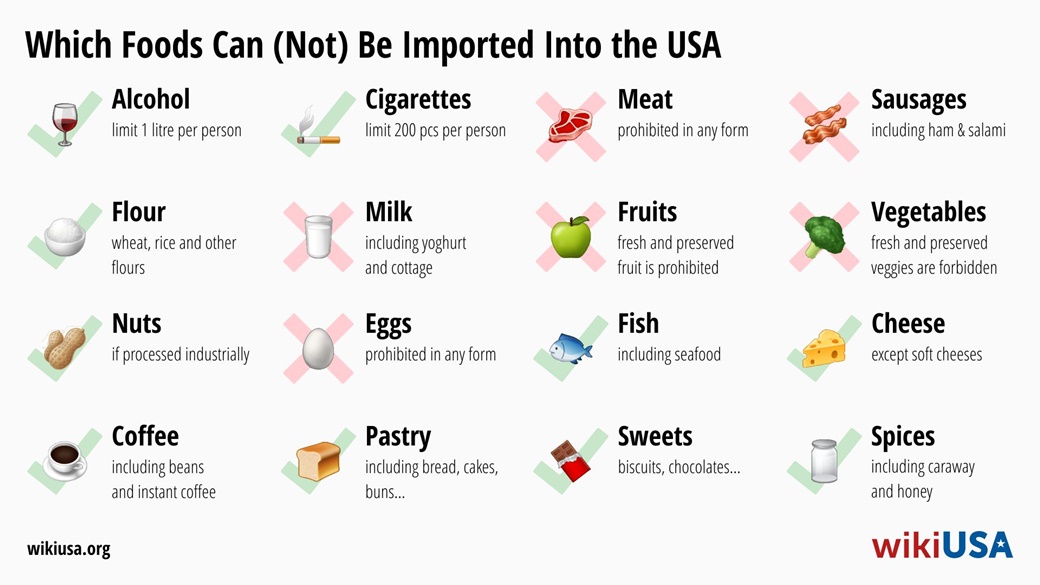
The rules outlined on this page apply to all travelers entering the USA. Food items are inspected in both checked and carry-on luggage. Food sent to the USA by mail is subject to the same regulations.
-
Table of Contents
Prohibited Food Items When Traveling to the USA
❌ Alcoholic Beverages
Individuals under the age of 21 are not permitted to bring alcohol into the USA, even as a gift.
All travelers, regardless of age, are prohibited from importing absinthe containing the chemical thujone. Absinthe is considered thujone-free if it contains less than 10 mg of thujone per liter. Product labels must not suggest hallucinogenic, psychotropic, or mind-altering effects. Bottles violating these rules will be confiscated.
❌ Meat and Meat Products
Salami, ham, sausages, cured meats, schnitzels, and other meat products, including canned meat, are not allowed into the USA. This includes fresh, frozen, dried, smoked, and thermally processed meat.
❌ Milk and Dairy Products
Milk, yogurt, cottage cheese, and other dairy products are prohibited from import into the USA. Exceptions include liquid and powdered milk intended for infant consumption. Butter, powdered milk, and dairy products that do not require refrigeration are allowed.
❌ Fruits and Vegetables
Most fruits and vegetables cannot be imported into the USA. Fresh, frozen, dried, or home-preserved fruits and vegetables are prohibited. Industrially processed fruits and vegetables are allowed if they are heat-treated and hermetically sealed. Dry goods such as beans, dates, figs, raisins, nuts, and peas are permitted.
❌ Eggs
The import of raw eggs and foods containing raw eggs is prohibited. Industrially manufactured foods containing cooked eggs are allowed.
-
Permitted Food Items When Traveling to the USA
✅ Alcohol
Individuals over 21 years old may bring 1 liter of alcohol into the USA duty-free. Importing larger quantities is not prohibited but may be subject to customs duties.
✅ Cigarettes, Cigars, and Tobacco
Up to 200 cigarettes, 50 cigars, or 2 kilograms of tobacco may be brought into the USA duty-free.
✅ Tea
Both bagged and loose-leaf tea can be imported into the USA without restrictions. Herbal teas may be inspected, and import is allowed if they do not contain plants listed on the USDA’s prohibited substances list. For this purpose, it is helpful if the packaging includes the scientific names of the ingredients.
✅ Mushrooms
Fresh, dried, and otherwise processed mushrooms may be imported into the USA. The only condition is that they must be cleaned and free of soil residue.
✅ Coffee
There are no restrictions on importing coffee beans or instant coffee into the USA. Any quantity may be brought in.
✅ Spices
Most spices, including cumin and baking powder, can be imported without restrictions. The import of orange, lemon, and lime leaves and seeds is prohibited. Based on experience, poppy seeds are likely to be confiscated.
✅ Honey
Honey for personal use may be imported without restrictions.
✅ Dairy Products
Milk intended for infant consumption, whether liquid or powdered, is permitted in amounts sufficient for several days’ use. Butter, powdered milk, and dairy products that do not require refrigeration are also allowed.
✅ Flour, Rice, and Pasta
Flour, including wheat, rice, oat, or corn flour, is allowed. White, brown, and basmati rice may be imported as long as it is husk-free. Pasta is allowed if it does not contain fresh eggs.
✅ Non-Alcoholic Beverages
Soft drinks, mineral water, and other non-alcoholic beverages may be imported without restrictions. Juices and powdered drinks should be transported in their original packaging with listed ingredients. If deemed suspicious, customs officers may confiscate the product.
✅ Nuts
Nuts that have been boiled, baked, ground, oven-dried, pureed, steamed, or otherwise heat-processed are allowed. Food items containing nuts can be imported unless they violate other regulations.
✅ Bakery Products
Bread, pastry, cookies, cakes, and other baked goods may be imported without restrictions.
✅ Fish and Seafood
Fish, shrimp, and other seafood may be imported for personal use. They can be fresh, smoked, frozen, cooked, dried, or canned. Caviar from endangered species under the CITES Convention may be imported in quantities up to 125 grams per person; amounts exceeding this limit will be confiscated. The import of protected seafood species under CITES and US federal laws is prohibited.
✅ Sweets, Chocolates, and Snacks
All types of sweets (cookies, chocolates, bars, cereals) and snacks (chips, crackers) are allowed as long as they do not contain prohibited ingredients such as meat, fresh eggs, or dairy requiring refrigeration.
✅ Cooking and Baking Ingredients
Oils, including olive, canola, and sunflower oil, as well as mustard, ketchup, and other condiments, can be imported. Dry baking mixes are allowed if they do not contain meat, fresh eggs, or other prohibited ingredients.
✅ Cheeses
Hard cheeses such as Parmesan, Edam, or Cheddar can be imported if made from pasteurized milk.
Soft cheeses such as Camembert, Brie, Feta, Mozzarella, Ricotta, or cream cheese in brine cannot be imported unless they are made from pasteurized milk and are brine-free.
This article covers the majority of food items most frequently brought into the USA by tourists. A complete list of regulations for importing food into the USA can be found on the U.S. Customs and Border Protection website.




Discussion (30)
Hey Hi how r u
Can i get pork sausages to Boston
@Joan Dsouza: Hi Joan! No, importing sausages into the US is not allowed. :-(
Can I bring spices in baggies /bulk or do they need to be in original labelled packages? Can I bring peanut butter?
@carolyn brock: Hi, it should be ok in bulk. Peanut butter is doable as well. :)
Please, can I import smoked fish and prawn into US to personal homes.
@Ronke: Hello, the smoked fish and prawns are fine and you can pack them for your trip.
I don’t understand why they ban the import of meat and milk (including its products)? :/
I assume it’s because of the bacteria and disease in it? It is one thing to transport it “industrially” in containers with refrigeration and another to have it “just like that” in the suitcase.
I just tried sending a package that had; chips, chocolate bars, and a small jar of maple syrup to Texas and it got returned to me with “prohibited by FDA.” What about my package was wrong?
Hey, Kris, that’s weird. As far as I know, none of those products are banned. Wasn’t there some kind of homemade maple syrup?
Was wondering if cooked spiced potatoes would be allowed to bring into the US coming from a country that doesn’t have a special agreement for this kind of thing with the States.
@F.A.: Hey, most likely yes, as long as the potatoes are fully cooked, do not contain meat or fresh plant material, and are intended for personal consumption. However, you must always declare these food items upon arrival to U.S. Customs and Border Protection, who have the final decision.
Can I bring cut vegetables (around 4 lb) for personal use.
@David Palmer: Hi, David. Cut vegetables intended for personal consumption are generally permissible to bring into the United States, provided they meet stringent USDA and APHIS requirements. You must declare all agricultural products upon arrival, and certain types of produce may be restricted or require additional inspection.
Hey Petr
can i bring veal stock (or base) for personal use cooking from France?
Thanks
@Yannick: Hey Yannick,
Yes, you can bring veal stock (or base) for personal use when traveling from France to the US, but there are some important considerations to keep in mind.
Veal stock must be declared to customs upon arrival. It’s essential to be clear that you are bringing it solely for personal consumption. You should also ensure that the veal stock is commercially packaged and unopened. Any homemade or loosely packed items may be denied entry.
hi i am travelling from india to dallas,texas in USA. can i carry legumes(Raw dal), rice, wheat flour, Besan(chana flour),presure cooker,belan,chakla with me for personal use in limited quantity.
@ANKIT GUPTA: Hi Ankit,
Yes, you can carry most of these items to the U.S., but with some restrictions. Legumes (raw dal), rice, wheat flour, and besan are generally allowed if they are clean, dry, and free of pests, though some agricultural products may require inspection. Pressure cookers, rolling pins (belan), and chakla are allowed as part of personal items in checked baggage. However, avoid carrying fresh fruits, vegetables, or items with seeds that could violate agricultural regulations. It is recommended to declare all food items at customs to avoid fines. :-)
I am in Cebu City Philippines and would like to bring home to the states some commercially packaged dried Mango slices.
@Tiger Thomas: Hi Tiger, commercially packaged dried Mango slices are ok to travel with. :-)
PS: Dried mango is the most yummy thing! ❤️🥭
Hey!
Im just thinking can i bring Salmiakki to USA?
@Petra: Hi Petra, salmiakki (candy) should be totally fine. :)
I’m traveling back to the US can I bring canned corned beef, canned luncheon meat and massages oil?
@Maria: Hi Maria,
you can generally bring commercially packaged, shelf-stable canned meats like corned beef and luncheon meat into the U.S., but they must be labeled and unopened.
Can I bring cooked salted duck eggs to US?
@LZ: Hi LZ,
bringing cooked salted duck eggs into the United States is generally not allowed. Even if the eggs are cooked and commercially packaged, they may still be confiscated at the border unless they meet specific USDA import requirements. To avoid issues, it’s best not to bring them. If you still wish to try, declare them upon arrival – failure to declare food items can result in fines. :-)
Can I bring commercially canned herring to the US?
@Maria Stedfeldt: Hi Maria, yes, you can bring commercially canned herring to the U.S.
Good evening Petr,
I will be flying to PHX from YVR on July 3rd and I was asked to bring grilled chicken from a restaurant. Enough for 2 people. Am I able to bring that through US Customs?
@Maria: Hi Maria,
yes, you can generally bring cooked, prepared chicken, such as grilled chicken, into the U.S. from Canada for personal use, as long as it is fully cooked and intended for immediate consumption. CBP allows most fully cooked poultry products from Canada, since Canada is not considered a high-risk country for animal diseases like avian influenza. However, the food must still be declared upon arrival.