
 10 Best Photo Places in the USA
California (CA) is located on the western coast of the country along the Pacific Ocean. It is the most populous state in the USA. The capital city is Sacramento, but by far the most well-known is Los Angeles. If California were an independent country, its economy would rank among the largest in the world. Major industries include technology, entertainment, and agriculture. Top tourist attractions include Hollywood, Universal Studios, Golden Gate Bridge, Alcatraz, and numerous national parks.

-
Table of Contents
Basic Information
Name California Abbreviation CA Capital Sacramento Largest city Los Angeles (Population: 3 820 914) Current time 11:55 Time zone PST (UTC-8), the state observes daylight saving time PDT (UTC-7) Population 39,538,212 (#1 most populous US state) Area 163,695 sqmi (#3 largest US state) Admitted to the Union September 9, 1850 (#31 state to join) ⭐ Capital of California
The capital of California is Sacramento, which was officially founded in 1850. It was designated as the capital that same year, following previous capitals Pueblo de San José de Guadalupe, Vallejo, and Benicia.
🏙️ Largest City in California
The largest city in California is Los Angeles, which had a population of 3,820,914 in 2023. The second largest city is San Diego with 1,388,320 residents, followed by San Jose with a population of 969,655.
🕒 Time in California
The current time in California is 11:55. The entire state follows Pacific Standard Time (PST, UTC-8), switching to Daylight Saving Time (PDT, UTC-7) from March to November.
🧑🤝🧑 California’s Population
According to 2023 data, California had a population of 39,538,212, making it the most populous state in the USA.
📍 Area of California
The total area of California is 163,695 sqmi, with 155,958 sqmi being land and 7,740 sqmi covered by water. California is the third largest state in the USA by area.
-
Fun Facts About the State of California
🧩 States That Border California
California shares its borders with three U.S. states: to the north is Oregon, to the northeast and south is Nevada, and to the east is Arizona. Additionally, it shares a land border with Mexico and has a 840 mi long coastline along the Pacific Ocean.
📅 Date California Joined the Union
California joined the Union on September 9, 1850, as the 31st state, when Mexican territory merged with what had previously been unorganized land.
📛 California’s Nickname
California is nicknamed “The Golden State”, a reference to its rich gold deposits and the largest gold rush in American history. Interestingly, neighboring Nevada is known as “The Silver State”.
⛰️ Highest Mountain in California
The highest mountain in California—and in the contiguous United States—is Mount Whitney, standing at 14,505 ft. It is located within Sequoia National Park and was named in honor of American geologist Josiah Dwight Whitney.
🏞️ Rivers in California
The longest river in California is the Colorado River, with a total length across all states of 1,448 mi. Other major rivers include the Sacramento River (447 mi), the San Joaquin River (365 mi), the Klamath River (257 mi), and the Pit River (207 mi).
🎓 Universities in California
The largest university system in the state is the University of California, which serves a total of 300,000 students. It was founded in 1868.
The largest campus is Los Angeles, with approximately 48,000 students. The second largest is Berkeley, with around 45,000 students, followed by San Diego, which has about 43,000 students.
✉️ ZIP Codes in California
California is assigned the ZIP code ranges 900xx–908xx, 910xx–928xx, and 930xx–961xx. You can look up the ZIP code for a specific address on the USPS website, and more information about how they work is available in the article ZIP Codes in the USA.
-
Weather in California
The best seasons to visit California are spring and fall, when the temperatures are pleasant. There are significant differences in temperature and climate across different parts of California. National parks are accessible, and nature is either in full bloom or painted in vibrant autumn colors.
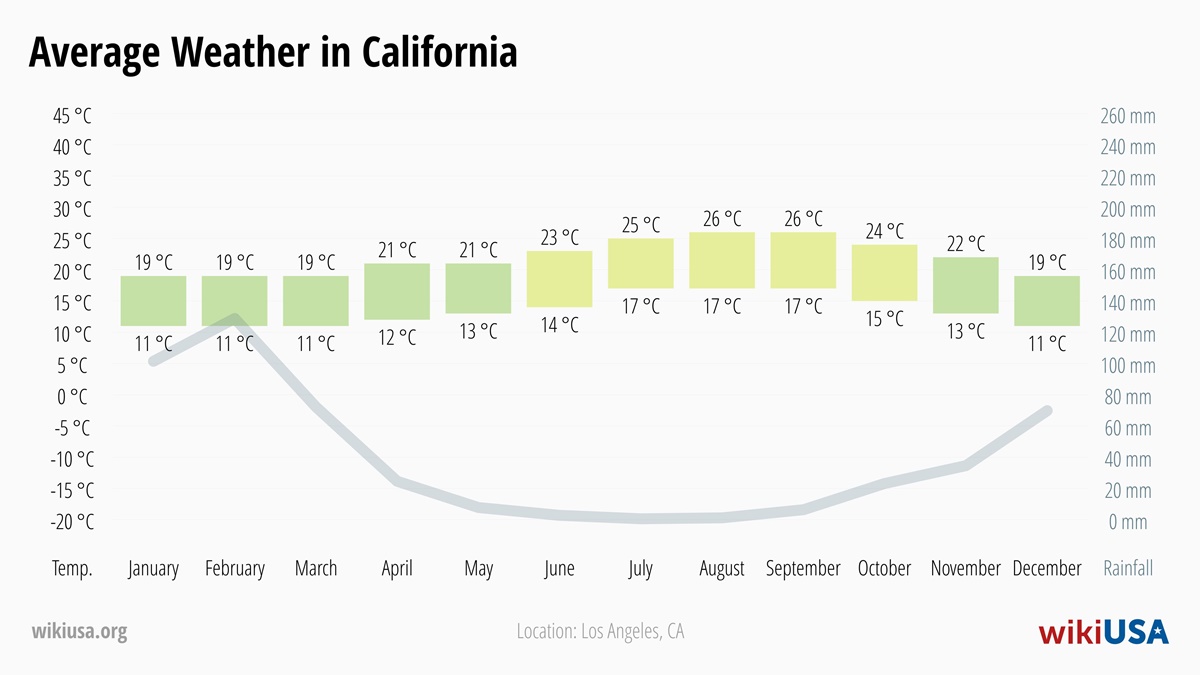
Spring in California brings temperatures around 59 °F to 68 °F, with sunny weather and low rainfall. Nature in the national parks awakens and begins to bloom.
Summer in California is hot. In Los Angeles, temperatures hover around 72 °F–79 °F due to the influence of the Pacific Ocean. Inland areas are significantly hotter, with temperatures climbing as high as 104 °F. Rainfall is minimal.
Fall in California, especially inland, brings a mild cooldown. In Los Angeles, the weather remains pleasant at around 64 °F to 72 °F. Due to dry weather and strong winds, some areas face a high risk of wildfires.
Winter in California varies by region. Coastal areas around Los Angeles remain mild, with temperatures ranging from 55 °F to 63 °F. In the Sierra Nevada and other mountain regions, snowfall is common, and temperatures drop below freezing.
🌡️ Average Temperatures and Rainfall in California
-
What to See in California
1️⃣ Yosemite National Park
Yosemite National Park is one of the most visited in the U.S., known for its massive rock formations dominated by El Capitan and Half Dome. The park’s main attractions include stunning waterfalls and giant sequoias.
The park is interwoven with hiking trails ranging from easy to extremely challenging, such as the 16.0 mi hike to the summit of Half Dome at an elevation of 8,839 ft. Yosemite offers plenty of camping opportunities and scenic views, allowing visitors to enjoy its beauty over several days.
2️⃣ Universal Studios Hollywood
A must-visit and a full day of fun for movie lovers, Universal Studios Hollywood combines real studios with attractions based on popular film franchises. The highlight of the visit is the studio tour, offering a behind-the-scenes look at film production.
If you’re lucky, you might witness the filming of an upcoming movie or TV episode. Many attractions are themed virtual roller coasters based on series like The Simpsons, Jurassic Park, or Harry Potter.
3️⃣ San Francisco
San Francisco and its surroundings offer entertainment for families and groups of friends for several days. One of the most popular attractions is the Alcatraz prison, located on an island and accessible to the public through organized tours.
The city’s world-famous symbol is the Golden Gate Bridge, which you can walk across for free. Don’t miss a ride on a historic cable car or a visit to the most winding street in the world, Lombard Street.
While walking through the city, explore Chinatown and Pier 39, known for its lively atmosphere and sea lions.
4️⃣ Sequoia National Park
Sequoia National Park, together with the adjacent Kings Canyon National Park, is located in central California. The park is renowned for its giant sequoias, the most famous of which is the 274.9 ft tall General Sherman, considered the largest tree in the world by volume since 2002. A popular attraction in the park is the Moro Rock viewpoint.
5️⃣ Hollywood
The Hollywood neighborhood is worth visiting in its own right, although in recent years it has struggled with issues related to homelessness and drug use. Both of its main attractions are free of charge.
The Hollywood Walk of Fame features nearly 3,000 star-engraved tiles honoring the biggest names in music, film, and theater. Before your visit, I recommend browsing the list of names and marking the locations of your favorite stars on a map.
You don’t even need to walk to see the second famous landmark—just look up. On the southern slope of Mount Lee, you’ll spot the Hollywood Sign, which stands 46 ft tall and stretches 361 ft long. It was originally built in 1923 as an advertisement for a real estate project.
6️⃣ Death Valley National Park
Death Valley National Park is the driest and hottest place on Earth. In 1913, a temperature of 134.0 °F was recorded here. Visitors to Death Valley can admire salt flats, vibrantly colored rock formations, and sand dunes. Among the park’s top attractions is Badwater Basin, the lowest point in North America, which descends to 282 ft below sea level at its deepest spot.
The park is open year-round, but due to extremely high summer temperatures, spring and fall are considered the best seasons to visit.
7️⃣ Monterey Bay Aquarium
The Monterey Bay Aquarium is considered one of the best in the world. Its massive tanks house sea otters, octopuses, and jellyfish. One of its most popular attractions is the feeding of sharks and other marine animals. Located right on the oceanfront, the Monterey Bay Aquarium is dedicated to the conservation and research of marine ecosystems. It’s a great destination for families with children or groups of friends.
8️⃣ Joshua Tree National Park
Joshua Tree National Park is among the most photogenic parks in the United States. Its charm lies in the short-leaf yucca trees scattered throughout the park among modest rock formations. A variety of hiking trails of different difficulty levels invite you to explore the landscape on foot.
Several campgrounds are located within the park and are open year-round. Spending a night in the park comes with another perk: stargazing. Thanks to minimal light pollution, conditions for observing the night sky are ideal.
9️⃣ Venice Beach
Venice Beach and neighboring Santa Monica are among the most iconic places in Los Angeles, where laid-back beach culture meets street art—and in recent years, unfortunately, homeless encampments. Still, the beach is well worth a walk and offers three distinctive landmarks.
The first is Muscle Beach, an outdoor gym that has stood since 1934 and where bodybuilders like Arnold Schwarzenegger once trained. Right next to it is a popular and freely accessible skate park.
A bit further along is the Santa Monica Pier, home to an amusement park and a small roller coaster.
🔟 Other National Parks in California
Several other national parks are well worth visiting. The Redwood National Park in the northwest of the state protects a coastline lined with redwoods reaching up to 377 ft tall. You can view massive rock walls—often in peculiar shapes—in Pinnacles National Park, one of the youngest national parks in the U.S.
One of the world’s largest volcanoes is visible in Lassen Volcanic National Park, which is also known for its hot springs and bubbling mud pots. Channel Islands National Park, off the coast of California, is one of the least visited parks. It consists of five islands with pristine nature and diverse ecosystems.
-
Largest Cities in California
The table shows the ten largest cities in the state of California in 2025, based on data from the federal agency United States Census Bureau, whose main responsibility is conducting the national census.
City County Population 1 Los Angeles Los Angeles 3,820,914 Map of Los Angeles 2 San Diego San Diego 1,388,320 Map of San Diego 3 San Jose Santa Clara 969,655 Map of San Jose 4 San Francisco San Francisco 808,988 Map of San Francisco 5 Fresno Fresno 545,716 Map of Fresno 6 Sacramento Sacramento 526,384 Map of Sacramento 7 Long Beach Los Angeles 449,468 Map of Long Beach 8 Oakland Alameda 436,504 Map of Oakland 9 Bakersfield Kern 413,381 Map of Bakersfield 10 Anaheim Orange 340,512 Map of Anaheim -
Sports Teams in California
🏒 Hockey (NHL)
Three teams from California compete in the NHL, all of which belong to the Pacific Division in the Western Conference.
The oldest franchise is the Los Angeles Kings, founded in 1967. Their team colors are black, silver, and white. They play their home games at Crypto.com Arena in Los Angeles.
The second-oldest team is the San Jose Sharks, which began play in 1991. The team plays its home games at SAP Center in San Jose. The Sharks’ colors are teal, white, black, and orange.
The youngest NHL team from California is the Anaheim Ducks, founded in 1993. They play their home games at Honda Center in Anaheim and use orange, metallic gold, black, and white as their official colors.
🏈 American Football (NFL)
California is home to three teams in the NFL.
The first to join the league, in the 1937 season, was the Los Angeles Rams, part of the NFC Western Division. The team plays its home games at SoFi Stadium in Inglewood and sports royal blue and sol-colored yellow-orange.
The San Francisco 49ers joined the league in the 1950 season, also in the NFC Western Division. They play at Levi’s Stadium in Santa Clara. The team’s colors are red, gold, and white.
The last to enter the NFL, in the 1970 season, were the Los Angeles Chargers, a member of the AFC Western Division. The team’s official colors are blue, gold, and white. The Chargers share SoFi Stadium with the Los Angeles Rams in Inglewood.
🏀 Basketball (NBA)
California has a strong presence in the NBA, with four teams competing regularly in the Pacific Division of the Western Conference.
The well-known Los Angeles Lakers entered the NBA in the 1948 season. They play all their home games at Crypto.com Arena in Los Angeles. The Lakers’ official colors are purple, gold, and black.
In the same 1948 season, the Sacramento Kings also joined the NBA. The team plays at Golden 1 Center in Sacramento. Their colors are black, royal purple, gray, white, and royal blue.
The Golden State Warriors began playing in the NBA in 1962, having relocated to California from Pennsylvania, where they competed as the Philadelphia Warriors starting in 1946. Their home games are held at Chase Center in San Francisco. The team’s colors are royal blue and yellow.
The fourth NBA team from California, the Los Angeles Clippers, joined in the 1970 season. They play home games at Intuit Dome in Inglewood. The Clippers use navy blue, red, Pacific blue, and silver as their team colors.
⚾ Baseball (MLB)
California also has a strong presence in Major League Baseball, with five teams competing in the Western Division.
The San Francisco Giants began playing in the National League in the 1883 season. Their team colors are black, orange, metallic gold, and cream. They play at Oracle Park in San Francisco.
The Los Angeles Dodgers first joined the National League in the 1890 season and now play their home games at Dodger Stadium in Los Angeles. Their team colors are blue, white, and red.
The third team is the Oakland Athletics of the American League, who played their first season in 1901. Their colors are green, gold, and white. They play their home games at Oakland Coliseum.
The Los Angeles Angels of the American League have participated in the league since the 1961 season. The Angels play at Angel Stadium in Anaheim. Their official colors are red, navy blue, and silver.
The San Diego Padres have been part of the National League since the 1969 season. They play home games at Petco Park in San Diego. Their colors are brown, gold, and white.
⚽ Soccer (MLS)
California has a strong presence in Major League Soccer (MLS), with four teams competing in the Western Conference.
The team LA Galaxy has been part of the league since the 1996 season and plays its home games at Dignity Health Sports Park in Carson. The team colors are navy blue, gold, and white.
Also debuting in the 1996 season was the club San Jose Earthquakes, which plays at PayPal Park. The official team colors of the San Jose club are blue, black, and white.
The third California-based team in MLS is Los Angeles FC, which joined the league in the 2018 season. It plays its home games at BMO Stadium in Los Angeles, and the team colors are black, gold, red, asphalt, and gray.
A newcomer to Major League Soccer as of the 2025 season is San Diego FC, with primary team colors of chrome and azure, complemented by blue, red, orange, and yellow. All home matches will be played at Snapdragon Stadium in San Diego.
-
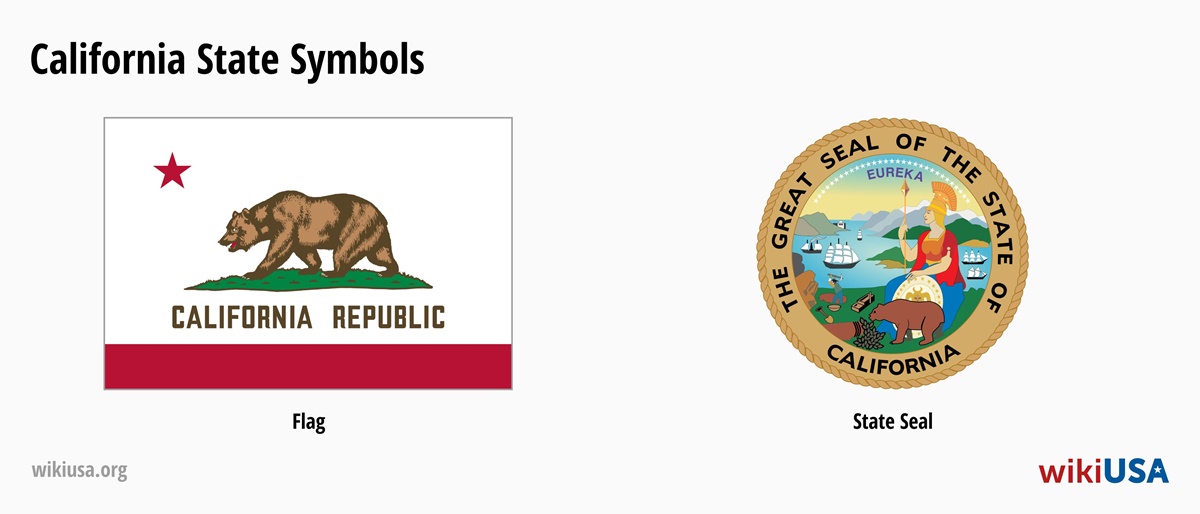
State Symbols of California
California defines a wide range of state symbols in its legislation; this article highlights just a few of them.
State Flag of California
California’s flag is one of the most recognizable in the United States and has existed in its current form since February 3, 1911. The flag’s dominant feature is a grizzly bear walking leftward on green grass. The illustration was created by artist Donald Graeme Kelley, and the flag was designed by William L. Todd. The bear is accompanied by a red stripe at the bottom, a red star in the top left corner, and the inscription “California Republic”.
State Seal of California
The Great Seal of California has been in use since 1849, although it has undergone several minor revisions over time. The central figure of the seal is Athena, the Greek goddess of wisdom, symbolizing that California was “born as an adult” and never held territorial status. She is accompanied by a grizzly bear, a grapevine, a sheaf of wheat, a miner, a gold prospector, and a bay with sailboats.
State Animal
Since 1958, California’s official state animal has been the California grizzly bear (Ursus arctos californicus), commonly referred to simply as the grizzly. Somewhat ironically, the last known grizzly in California was seen near Yosemite National Park in 1924.
State Colors
In 1951, California designated blue and gold as its official state colors. Blue represents the sky, while gold alludes to the precious metal that triggered the Gold Rush in the spring of 1848.
State Marine Mammal
The gray whale (Eschrichtius robustus) was named California’s official marine mammal in 1975. This animal, measuring 49 ft long and weighing an average of 59,525 lb, is commonly found along California’s coast.
State Bird
In 1931, legislators passed a law declaring the California quail (Callipepla californica) the official state bird. This small, ground-dwelling bird averages 26 cm in length and is found almost exclusively along the western coast of California and the Mexican state of Baja California.
State Theater
California’s legislature also designated an official state theater—the Pasadena Playhouse in the city of Pasadena—which received this designation in 1937. The theater, designed in Spanish Colonial Revival style, hosted its first performance in 1924.
State Fruit
In 2013, the avocado was named California’s unofficial state fruit. Approximately 3,000 farmers across the state are involved in cultivating the Hass avocado.
State Mineral
Gold was officially recognized as a state symbol in 1965, though it had long been considered one informally. The story began on January 24, 1848, when carpenter and mill worker James Wilson Marshall discovered the first gold deposit in the town of Coloma near Sacramento. News of the discovery spread quickly, attracting about 300,000 gold seekers from across the United States and abroad to California.
State Fabric
Since 2016, California has had an official state fabric: denim. Denim jeans have long been the traditional attire of California gold miners, laborers, hippies, and rock stars. The bill enacting this symbol is numbered 501, referencing the most iconic jeans model from California-based brand Levi’s.




Contribute with Your Question or Personal Experience