
 10 Best Photo Places in the USA
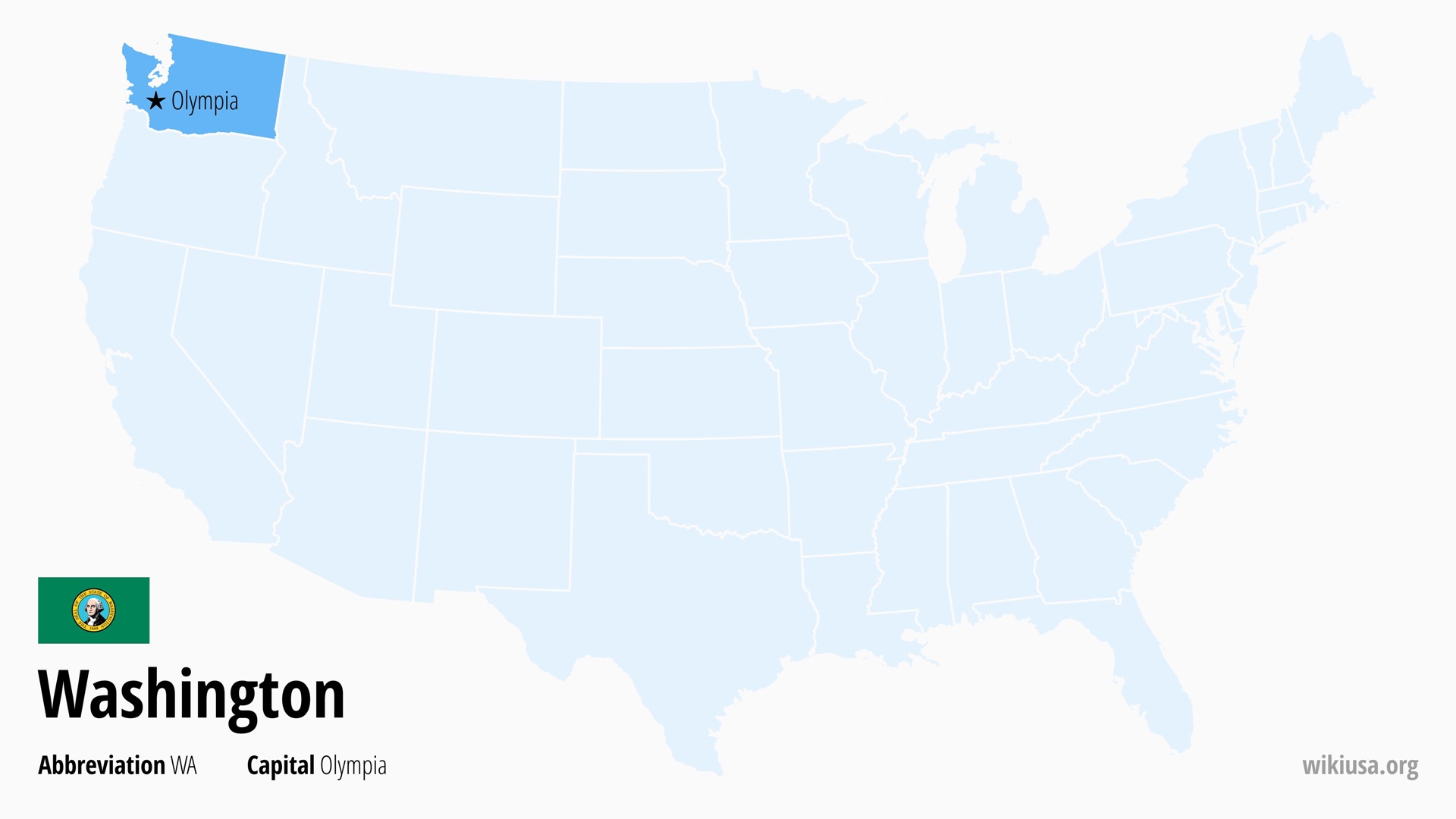
Washington (WA) is located in the northwest of the USA near the border with Canada, the state mixes beautiful nature and developed technological industry. The local economy is heavily influenced by the headquarters of Microsoft, Amazon, and Starbucks. Major tourist attractions include Olympic National Park, Mount Rainier, North Cascades and the Space Needle tower in downtown Seattle. The capital of Washington is Olympia, the largest city by far is Seattle.
-
Table of Contents
Quick Facts
Name Washington Abbreviation WA Capital Olympia Largest city Seattle (Population: 755 078) Current time 6:51 Time zone PST (UTC-8), the state observes daylight saving time PDT (UTC-7) Population 7,705,267 (#13 most populous US state) Area 71,362 sqmi (#18 largest US state) Admitted to the Union November 11, 1889 (#42 state to join) ⭐ Capital of Washington
Olympia first became the capital of Washington Territory in 1853 and then the capital of Washington after Washington entered the Union in 1889. The city took its name from the Olympic Mountains.
🏙️ Largest City in Washington
The largest city in Washington State is Seattle, with a population of 755,078 in 2023. The second largest city is Spokane with a population of 229,447 and the third largest city is Tacoma with a population of 222,906.
🕒 Time in Washington
The current time in Washington State is 6:51. Pacific Standard Time (PST, UTC-8) is in effect throughout the state. Like most of the USA, Washington switches to Daylight Saving Time between March and November.
🧑🤝🧑 Population of Washington
In 2023, Washington State had a total population of 7,705,267, making it the 13th most populous state in the United States.
📍 Area of Washington
The total area of Washington State is 71,362 sqmi, of which 66,636 sqmi is land and 4,726 sqmi is water. Washington is the 18th largest US state.
-
Fun Facts About Washington State
🧩 Washington Neighboring States
Washington is bordered by just two US states, Idaho to the east and Oregon to the south. In addition, it has a border with the Canadian province of British Columbia to the north and a 157 mi long Pacific coastline to the west.
📅 Date of Washington Statehood
Washington was admitted to the Union on November 11, 1889, as the 42nd state in the order. Its predecessor was Washington Territory.
📛 Nickname of the State of Washington
The state is unofficially nicknamed “The Evergreen State”, a reference to Washington’s evergreen nature, which is due to its frequent rains. The nickname dates back to 1890, and its probable author is Seattle journalist and advertising executive Charles T. Conover.
“The Evergreen State” still appears on the license plates of cars registered in Washington State.
⛰️ Highest Mountain in Washington
Washington’s highest peak is the potentially active volcano Mount Rainier, with an elevation of 14,410 ft, which is also the highest point in the Cascade Range. The mountain, also known as Tahoma, is located within Mount Rainier National Park about 59 mi southeast of Seattle.
🏞️ Rivers in Washington
The longest river in Washington State is the Columbia River with a total flow length of 1,243 mi. It is followed by the Snake River (1,078 mi), the Yakima River (214 mi), the Grande Ronde River (182 mi), and the Kettle River (175 mi).
🎓 Universities in Washington
The largest university in the state is the University of Washington, which was founded in 1861 in Seattle and today has just under 60,000 students.
In second place is Washington State University with 31 thousand students, it is located in the city of Pullman and its tradition dates back to 1890. The third largest university is Western Washington University from the city of Bellingham, founded in 1892 and attended by 16 thousand students.
✉️ Washington ZIP Codes
The state of Washington has dedicated ZIP code ranges 980xx-986xx and 988xx-994xx, you can search by address on the USPS website. For more information and an overview map, see the ZIP Codes in the USA article.
-
Weather in Washington
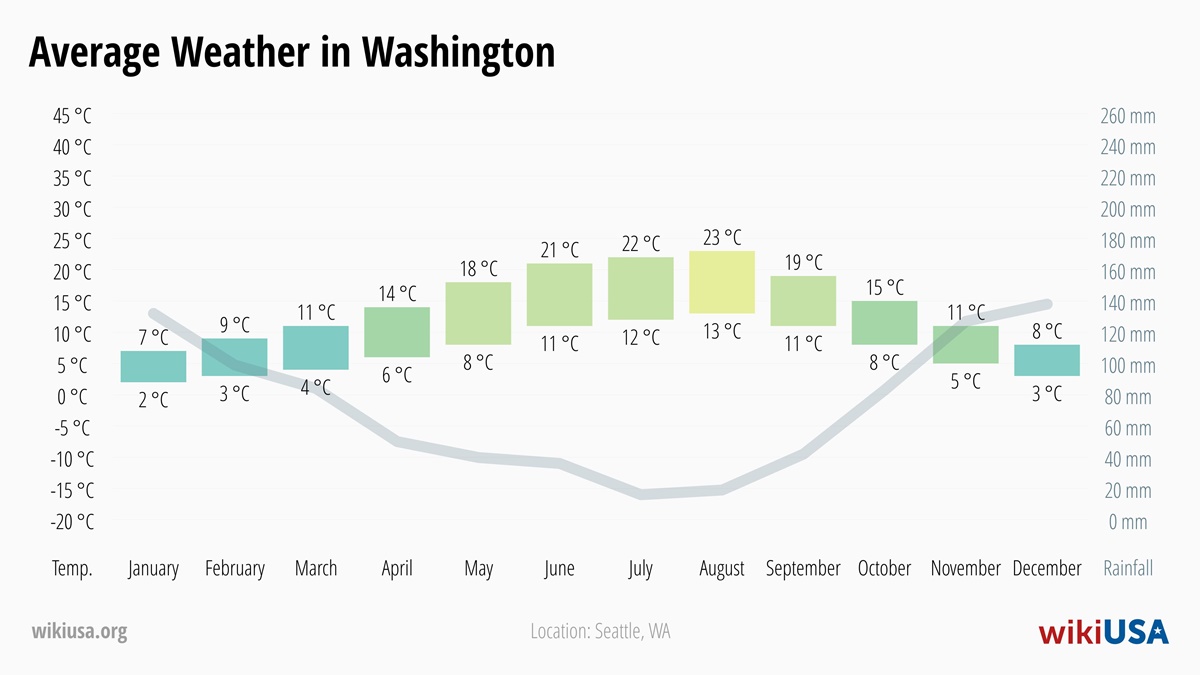
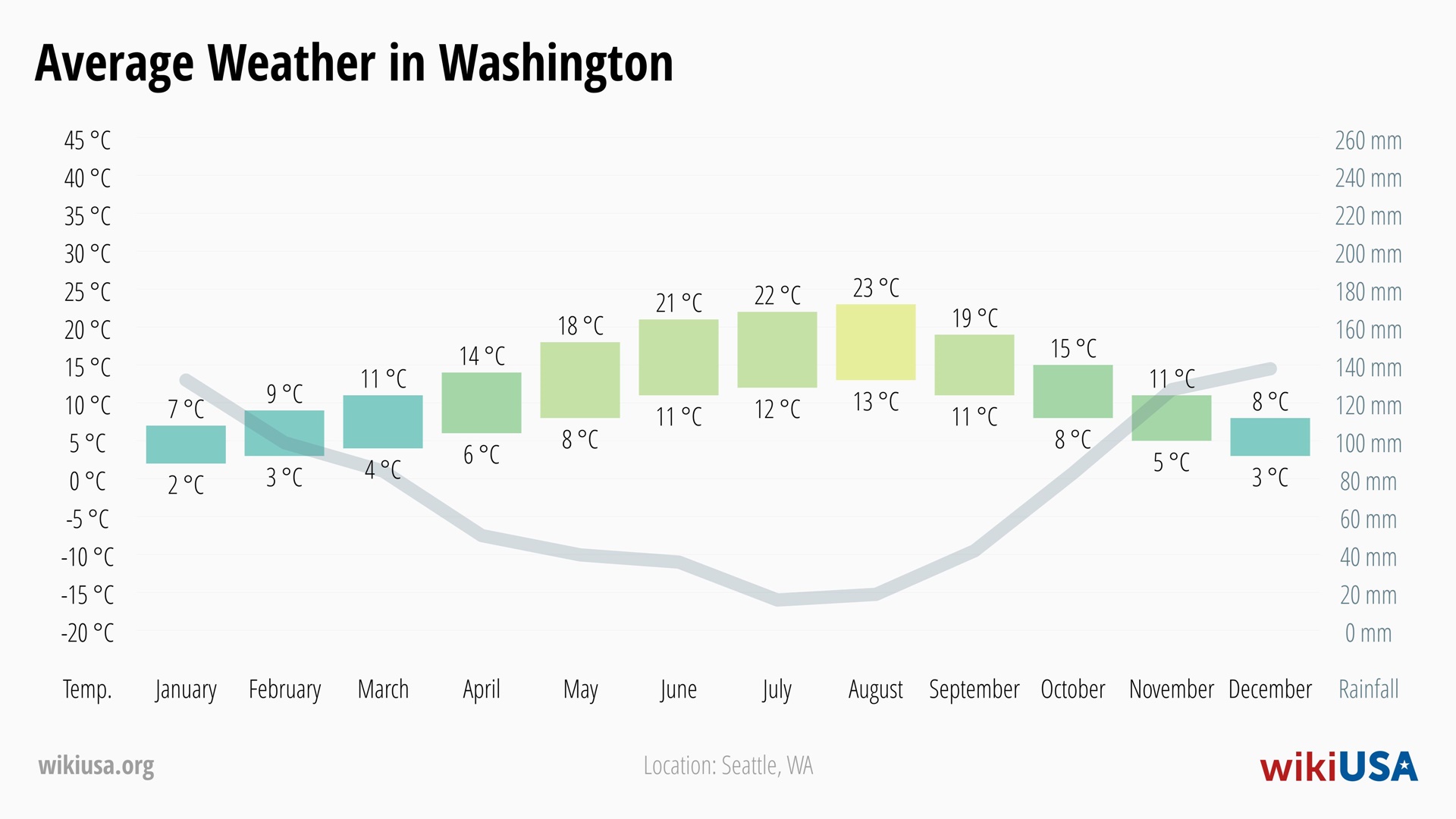
The best time to visit Washington State is summer, when the weather is consistent and mostly sunny. This makes the conditions ideal for hiking and exploring the natural beauty.
Springtime in Washington differs in the western and eastern parts of the state. In the west, and especially around Seattle, springs tend to be milder with temperatures around 50 °F to 59 °F, with frequent rainfall, especially in March and April. In eastern Washington, temperatures are cooler (around 41 °F to 50 °F), but rainfall is also less.
Summer in Washington is generally dry with low rainfall. In the west, temperatures range between 63 °F and 72 °F, while the eastern half of the state is sunnier with normal temperatures between 79 °F and 88 °F.
Autumn in Washington brings cooling to 50 °F to 59 °F and the return of rainfall, with the heaviest rain usually falling in November.
Winter in Washington is varied. Temperatures in the West range from 34 °F to 43 °F, with frequent rain showers. Eastern Washington is colder, with winter temperatures dropping to 14 °F. Snowfall is more frequent in these places, with snow cover common at higher elevations.
🌡️ Average Temperatures and Precipitation in Washington
-
Things to Do in Washington
1️⃣ Olympic National Park
Located in western Washington, Olympic National Park is unique in its diversity as it alternates between beaches, mountains, wilderness and rainforest. The Hoh Rainforest, with its giant moss-covered trees, or the coastal area of Rialto Beach, with its driftwood, are among the places to see for yourself.
Other popular activities in the park include camping, fishing and wildlife watching, with squirrels, skunks, coyotes, river otters and foxes to be spotted.
2️⃣ Space Needle Tower
The Space Needle is a 605 ft tall tower and unmistakable symbol of Seattle that opened in 1962 for the World’s Fair. At 520 ft is an observation deck with 360-degree views of the city, bay and mountains. An adrenaline-fueled version of the observation deck is The Loupe, from which you can watch the action below the tower through a glass revolving floor. The attraction is part of the restaurant of the same name.
3️⃣ Mount Rainier National Park
Mount Rainier National Park was created in March 1899 to help protect the wildlife around the active volcano of the same name, which is the highest mountain in Washington State with 14,410 ft. The park has marked over 260 mi trails for hiking, and conditions are also very good for rock climbing and wildlife viewing. The area is famous for its meadows, which are full of wildflowers, waterfalls and glaciers.
4️⃣ The Museum of Flight
The Museum of Flight in Seattle is one of the largest aerospace museums in the world. Its collection includes historic aircraft, a lunar lander, and an off-road exploration vehicle used on the Moon. Visitors can see the first Air Force One jetliner, British Airways’ supersonic Concorde or a restored Lockheed L-10 Electra.
Interactive simulators are an interesting attraction, and the museum also hosts educational programs and lectures. For technical enthusiasts and families with children, this is a good place to visit.
5️⃣ North Cascades National Park
The North Cascades National Park is located in the north of the state near the border with Canada, characterized by its glaciers and steep mountains with heights up to 9,199 ft. The park is a popular destination for hikers, with over 400 mi trails of varying difficulty leading to turquoise lakes such as Diablo Lake and Ross Lake.
There are also good conditions for camping and wildlife watching, with moose, beavers, river otters and black bears to be spotted.
6️⃣ Snoqualmie Falls
Snoqualmie Falls are 268.0 ft high waterfalls that are a 40-minute drive east from downtown Seattle. Visitors can admire the falls from the observation deck or descend to the base of the falls via a trail. The falls are one of the most visited natural attractions in Washington, and are accessible year-round.
7️⃣ Pike Place Market
Seattle’s Pike Place Market is one of the oldest markets in the United States, having opened on August 17, 1907. Farm stands, bakeries, restaurants, and craft shops are open 363 days a year. Interestingly, the world’s first Starbucks coffee shop opened in Pike Place Market on March 30, 1971. The park hosts regular food festivals, farmers markets and other cultural events.
8️⃣ Museum of Pop Culture
The Museum of Pop Culture is housed in an architecturally distinctive building in Seattle on the site of the former World’s Fair, opened in 2000. The entire building was funded by Microsoft founder Paul Allen, who wanted to dedicate it to local native Jimi Hendrix.
The museum’s exhibitions are continuously renewed, focusing on films, video games, fantasy, science fiction literature, or video games. Visitors can also visit interactive studios for music recording and sound experiments.
9️⃣ Seattle Aquarium
Located on Pier 59 near downtown, the Seattle Aquarium offers visitors a chance to marvel at marine life in the Pacific Northwest. The main attraction is an underwater dome with a 260-degree view of the aquarium, where sharks, salmon, great crested newts, sturgeon and redfish swim.
In another section is the “touch aquarium” where visitors can touch more than a hundred invertebrates. With over 12,000 creatures of 400 different species living in all the tanks, the aquarium is a great place for a family day out.
🔟 Tulip Festival in Skagit Valley
The largest tulip festival in North America is held annually in April in the Skagit Valley of northwest Washington. Visitors to the festival can admire millions of vibrant tulips that complement art exhibits, farmers markets, and street fairs. Just before visiting the festival, it’s worth checking the current condition of the tulips, which are sensitive to the weather.
-
Largest Cities in Washington
The table below shows the ten largest cities in Washington State in 2023, the source of the data is the United States Census Bureau, a federal agency whose main job is to count the population.
City County Population 1 Seattle King 755,078 Map of Seattle 2 Spokane Spokane 229,447 Map of Spokane 3 Tacoma Pierce 222,906 Map of Tacoma 4 Vancouver Clark 196,442 Map of Vancouver 5 Bellevue King 151,574 Map of Bellevue 6 Kent King 133,378 Map of Kent 7 Everett Snohomish 111,180 Map of Everett 8 Spokane Valley Spokane 108,235 Map of Spokane Valley 9 Renton King 104,491 Map of Renton 10 Federal Way King 97,701 Map of Federal Way -
Sports Teams in Washington
🏒 Ice Hockey (NHL)
Only the Seattle Kraken play in the NHL franchise, which was only founded in 2021, making them one of the youngest participants in the competition. The club plays its home games at Climate Pledge Arena in Seattle and is part of the Pacific Division in the Western Conference. The club’s colors are four different shades of blue and red.
🏈 American Football (NFL)
The only NFL participant from the state of Washington since the 1976 season is the Seattle Seahawks of the NFC West Division. The club plays its home games at Lumen Field in Seattle, choosing navy blue, green, and gray as its symbolic colors.
🏀 Basketball (NBA)
Washington is not represented in the NBA basketball league.
⚾ Baseball (MLB)
Washington is represented in MLB baseball by the Seattle Mariners, who have been part of the American League since the 1977 season. The club plays its home games at T-Mobile Park in Seattle, and its team colors are navy blue, metallic silver, northwest green, royal blue, yellow, and cream.
⚽ Soccer (MLS)
Seattle Sounders FC has participated in the MLS soccer league since the 2009 season, assigned to its Western Conference. The club plays its home matches at Seattle’s Lumen Field; the team colors are blue, green, and slate.
-
Washington State Symbols
Washington State has a number of legally recognized state symbols, here in this article I list just a few of them.
State Flag of Washington
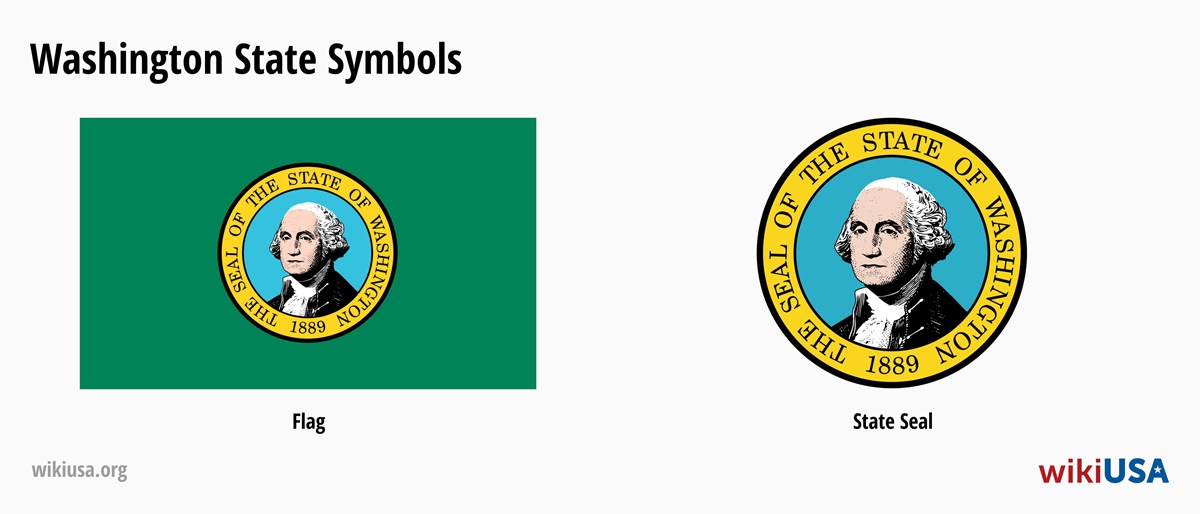
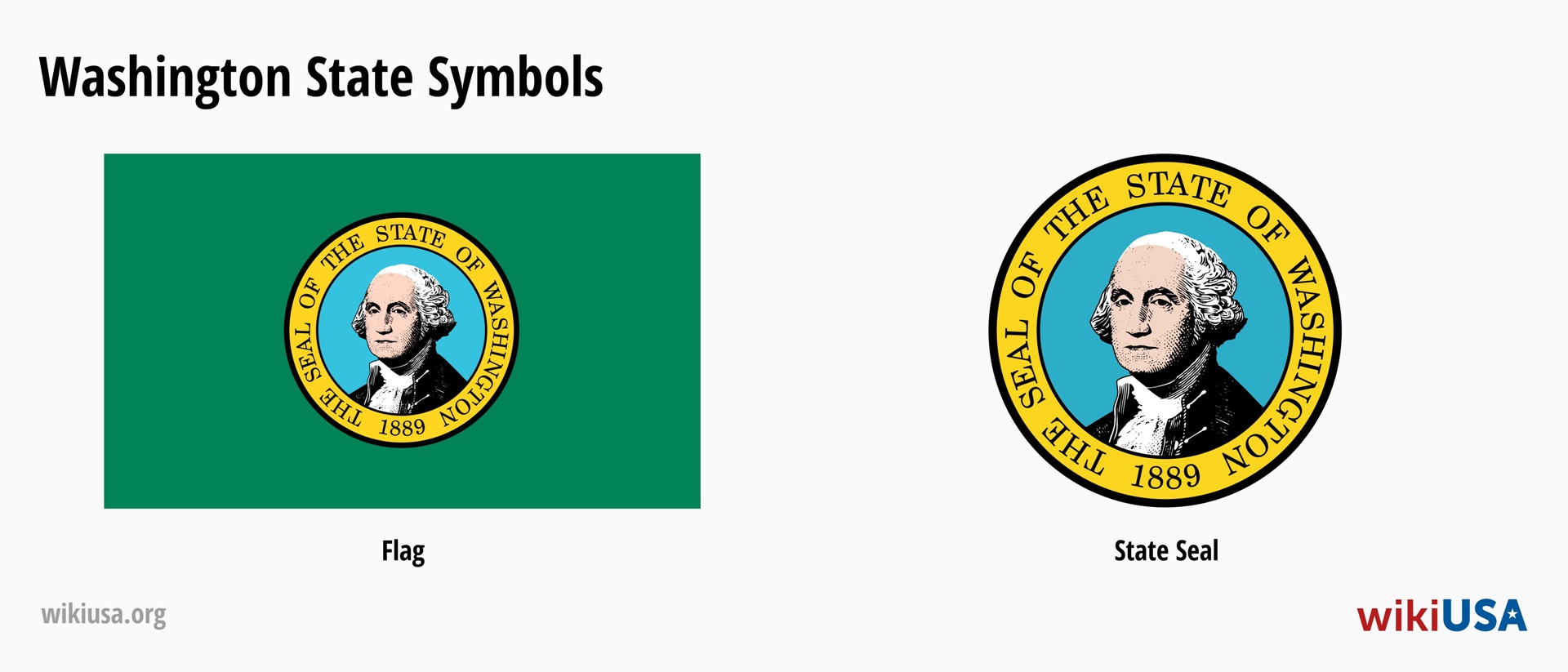
The state flag was officially adopted on March 5, 1923, although its design has changed several times since then. The flag’s motif is the Washington State Seal with the name of the eponymous former president on a green field. The background color symbolizes nature and forests, while the portrait recalls the legacy of the first US President.
Washington is the only US state to have a portrait of the President on its flag and the only one with a green background.
Great Seal of Washington
The Great Seal is used to authenticate documents issued by the Washington State government. The first seal was adopted in 1889 and features a portrait of President George Washington by the artist Gilbert Stuart. The year 1889 refers to the year Washington entered the Union.
State Song
Washington, My Home became the official national anthem in 1959. The lyrics were written by Helen Davis, who used adapted music from Stuart Churchill’s “America, My Home”.
State Bird
Washington’s state bird is the American goldfinch (Spinus tristis), which can be seen primarily in rural Washington. It became the state symbol in 1928 at the suggestion of elementary school children.
State Fish
Since 1969, Washington’s symbol has been the rainbow trout (Oncorhynchus mykiss), one of the most popular species for local sport fishermen. The rainbow trout is known for its ability to survive in a variety of aquatic environments, which is meant to symbolize the ability of Washingtonians to adapt.
State Amphibian
In 2007, the Pacific tree frog (Pseudacris regilla) became the symbol, which lives on both sides of the Cascade Mountains and in every county in Washington State. The frog is characterized by its loud croak and its ability to change skin color, which helps camouflage it from predators.
State Tree
Washington’s state tree is the western hemlock (Tsuga heterophylla), which is one of the most common trees in local forests. The symbol was enacted in 1946 when an article in The Portland Oregonian newspaper called attention to the fact that Washington did not have a state tree.
State Endemic Mammal
The Olympic marmot (Marmota olympus) is one of the few native mammal species in Washington. It is commonly found throughout the Olympic Peninsula and can be seen in Olympic National Park along Hurricane Ridge during the summer months. It became a state symbol in 2009 in an effort to draw attention to the rare endemic species.
State Gem
In 1975, the petrified wood, which is found in nearly every Washington county, became one of the state symbols. Petrified wood is formed when water permeates the wood and replaces its fibers with silicon. One of the most well-known sites of petrified wood in Washington is Ginkgo Petrified Forest State Park.
State Fruit
A law passed in 1989 made apples the official state fruit. Washington is the largest producer of apples of any state, producing up to half of the USA production, according to some sources.



Contribute with Your Question or Personal Experience