
 10 Best Photo Places in the USA
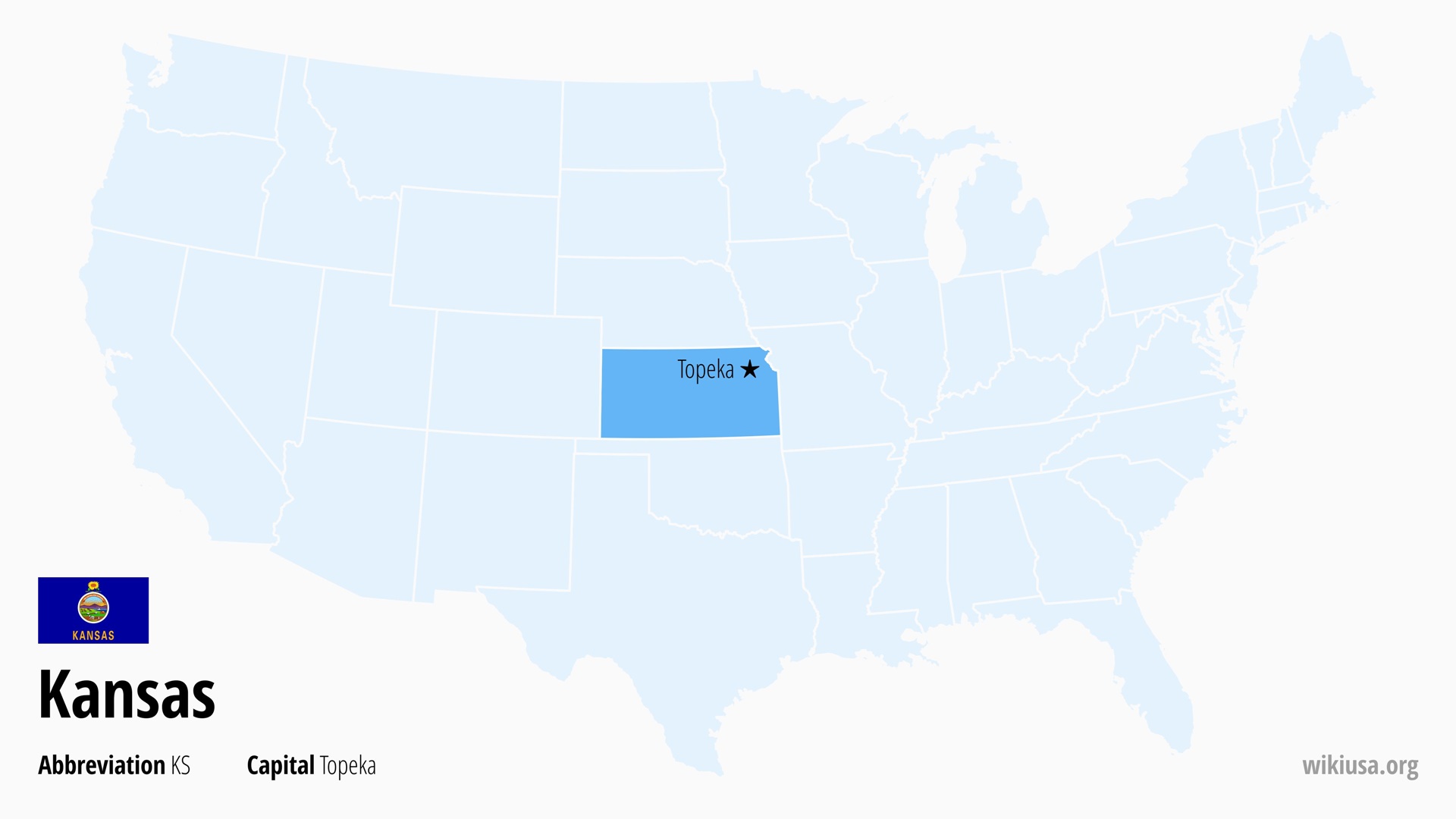
Kansas (KS) lies near the geographic center of the continental USA. The state is known for its endless prairies and authentic Wild West atmosphere. Wheat production, agriculture, and manufacturing are important to the Kansas economy. The capital of Kansas is Topeka, but Wichita is the largest city. Tourist attractions include the Hutchinson Aerospace Museum.
-
Table of Contents
Quick Facts
Name Kansas Abbreviation KS Capital Topeka Largest city Wichita (Population: 396 119) Current time 6:44 Time zone CST (UTC-6) is in effect in most of the state, MST (UTC-7) is in effect in Greeley, Hamilton, Sherman and Wallace counties to the west. The state observes daylight saving time CDT (UTC-5) and MDT (UTC-6) Population 2,937,835 (#35 most populous US state) Area 82,278 sqmi (#15 largest US state) Admitted to the Union January 29, 1861 (#34 state to join) ⭐ Capital of Kansas
The capital of Kansas is Topeka, which was founded in 1854 as one of the first cities in the territory to speak out against slavery. The name Topeka comes from the Native American language and translates to “a good place to dig potatoes”. Topeka has been the capital of Kansas since 1861, when the state gained statehood.
🏙️ Largest City in Kansas
The largest city in Kansas is Wichita, with a population of 396,119 in 2023. The second most populous city is Overland Park with 197,089 residents and the third-largest city is Kansas City with 152,933 residents.
🕒 Time in Kansas
The current time in most of Kansas is [timezone=”America/Chicago” format=”G:i”]. Most of the state follows Central Standard Time (CST, UTC-6), with a switch to Daylight Saving Time CDT (UTC-5) from March to November. Only a few counties in western Kansas recognize Mountain Standard Time (MST, UTC-7), however, Daylight Saving Time is in effect for part of the year there.
🧑🤝🧑 Population of Kansas
As of 2023, Kansas had a population of 2,937,835, making it the 35th most populous state in the USA.
📍 Area of Kansas
The total area of Kansas is 82,278 sqmi, of which 81,758 sqmi is land and only 520 sqmi is water. Kansas is the 15th largest state in the USA.
-
Fun Facts About Kansas
🧩 Kansas Neighboring States
Kansas is bordered by four American states. Colorado to the west, Nebraska to the north, Missouri to the east and Oklahoma to the south.
📅 Date of Kansas Statehood
Kansas was admitted to the Union on January 29, 1861, as the 34th state in line to secede from the original Kansas Territory.
📛 Nickname of the State of Kansas
The official nickname of Kansas is “The Sunflower State”, referring to the wild sunflowers, of which there are eleven different species in the state. The sunflower became the official flower of the state in 1903.
The second nickname, “The Wheat State”, was given to Kansas because it is one of the largest wheat producers in the USA. According to some sources, Kansas mills are the largest producers of wheat of any US state.
⛰️ Highest Mountain in Kansas
The highest point in Kansas is with 4,039 ft Mount Sunflower, located near the border with Colorado.
🏞️ Rivers in Kansas
The longest river flowing through Kansas is the Missouri River, with a total length of flow of 2,343 mi across several states. It is followed by the Arkansas River (1,469 mi), the Cimarron River (698 mi), the Smoky Hill River (559 mi), and the Neosho River (463 mi).
🎓 Universities in Kansas
The largest university in Kansas is the University of Kansas, which was founded in 1865 in Lawrence and is attended by around 28,000 students. The second largest is Kansas State University with around 15 thousand students and the third largest is Wichita State University with around 13 thousand students.
✉️ Kansas ZIP Codes
Kansas has dedicated zip code ranges of 660xx-662xx and 664xx-679xx. You can look up the ZIP code for a specific address on the USPS website, read more about how they work in the article ZIP Codes in the USA.
-
Weather in Kansas
The best time to visit Kansas is in September and early October, when temperatures are comfortable and there is less risk of thunderstorms compared to previous months. The deciduous trees turn shades of orange and red in autumn, creating a pleasant atmosphere when exploring the beauty of nature.
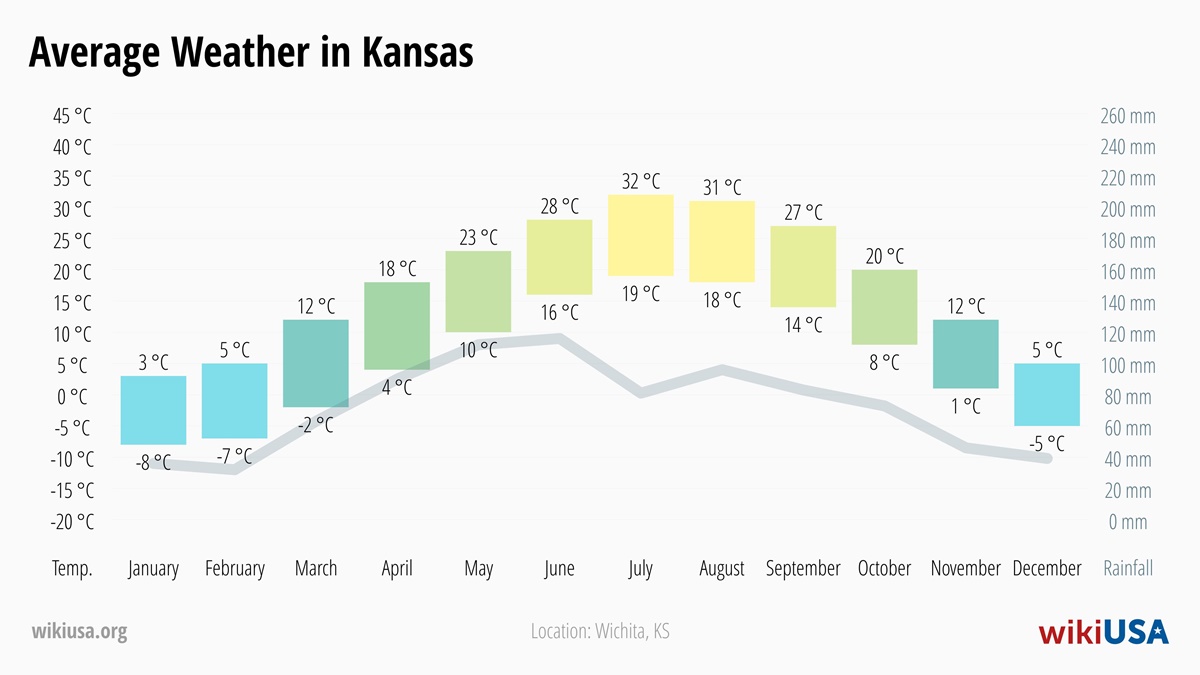
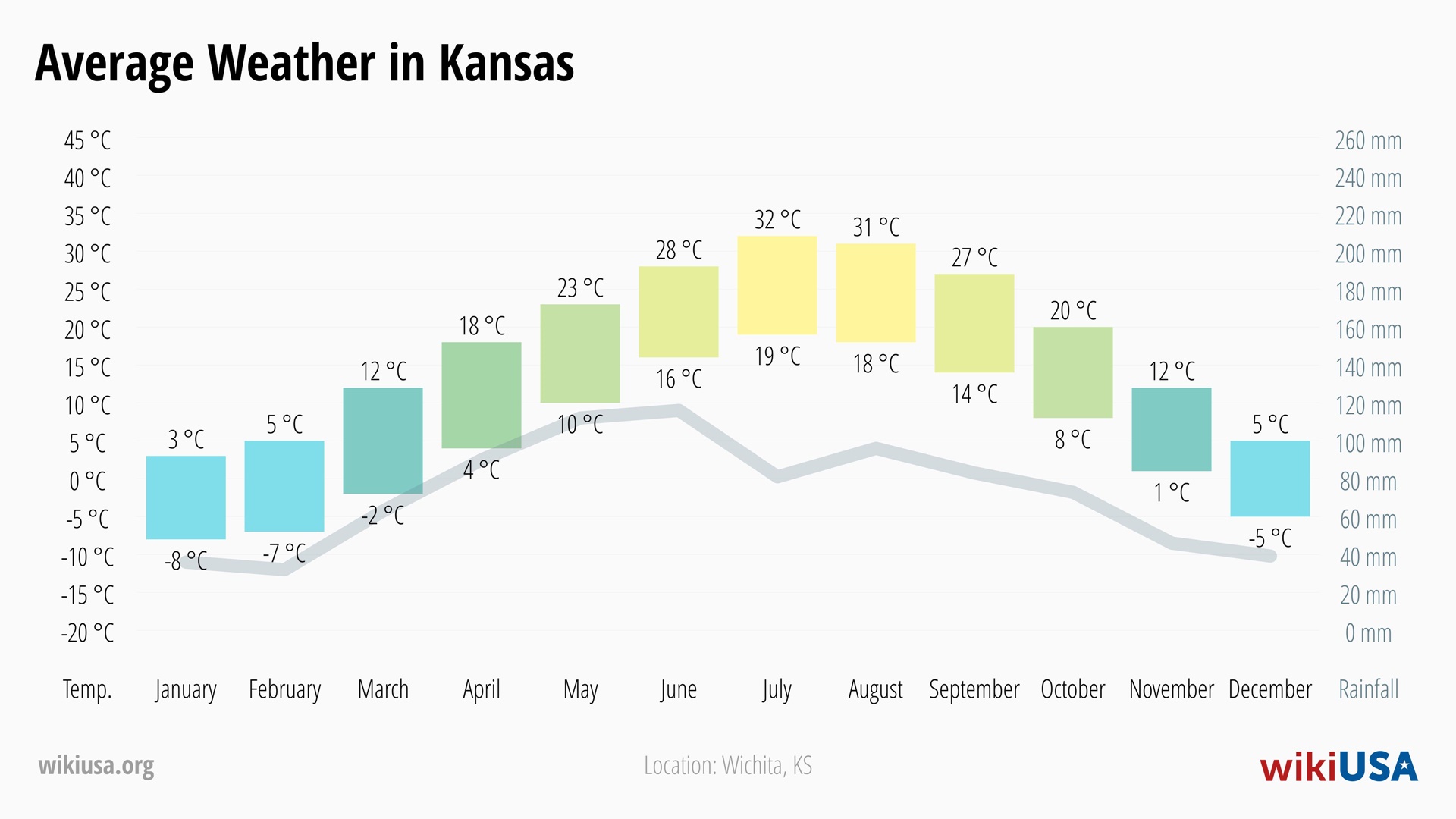
Spring in Kansas is marked by changeable weather. In March, average temperatures in Wichita range between 37 °F and 63 °F, but rise to a pleasant 50 °F in May and 73 °F in May. Severe thunderstorms accompanied by hail or dangerous tornadoes are typical for spring, and are more likely to occur in the western part of the state. Although rainfall is frequent, it is usually short and intense showers.
Summers in Kansas are generally dry and very hot. Temperatures between June and August range from 72 °F to 90 °F. The western part of the state tends to be drier, with more frequent thunderstorms accompanied by intense rain showers in eastern Kansas. The risk of tornadoes is highest in spring and early summer due to variable temperatures and severe thunderstorms. Long, sunny days are ideal for outdoor activities, but very high temperatures should be expected.
Fall in Kansas brings relief from the summer heat as temperatures gradually drop from September’s 57 °F to 81 °F to November’s usual 34 °F to 54 °F. Rainfall is sporadic and may be accompanied by thunderstorms during frontal transitions. The risk of tornadoes is low, making autumn a good time for hiking and being outdoors.
Winter in Kansas is very cold, with temperatures ranging from 18 °F to 41 °F most days. In the north of the state in particular, temperatures can drop well below 14 °F, and snow showers are also more likely in this area. Strong winds add to the feeling of freezing weather, and ice storms can cause traffic complications.
🌡️ Average Temperatures and Precipitation in Kansas
-
Things to Do in Kansas
1️⃣ Kansas State Capitol
The Capitol Building in the state capital of Topeka is one of the most important buildings in Kansas. Built between 1866 and 1903 in the French Renaissance Revival style, the most architecturally interesting features are the richly decorated interiors and frescoes. Visitors can explore the building’s interiors on a free tour. The highlight of the tour is the opportunity to enter the top of the dome, which offers a beautiful view of the surrounding area.
2️⃣ Cosmosphere Space Museum
The Cosmosphere in Hutchinson is one of the largest space museums in the world. Visitors can see an extensive collection of exhibits, including items from American and Soviet space missions. Among the museum’s biggest attractions are the original Apollo 13 spacecraft and rare items from the space race era. The Cosmosphere Museum includes a planetarium and an IMAX theater.
3️⃣ Boot Hill Wild West Museum
The Boot Hill Museum focuses on the Wild West in the 19th century and includes a replica of a historic western town with shops, a bar and a jail. The exhibit includes reenactments of gunfights and cowboy performances. The museum is located in Dodge City in southwest Kansas.
4️⃣ Strataca – Underground Salt Mining Museum
A unique look at salt mining in Kansas is offered by the Strataca Museum in Hutchinson. There, visitors descend in an elevator to 2,133 ft underground, where they can see the vast salt mines firsthand and learn more about their history. The tour includes a ride on an underground mine train. The salt mine began operations in 1923.
5️⃣ Monument Rocks
Monument Rocks National Monument consists of more than 80 million-year-old Cretaceous formations with rich fossil deposits. One of the first natural monuments in the USA, it is also known as the Chalk Pyramids, with the largest formations reaching up to 70.0 ft. There are no restaurants or shops around the monument, so bring plenty of food and water.
6️⃣ Quivira National Nature Reserve
Quivira National Wildlife Refuge is home to thousands of migratory birds, including several endangered species, and is located in central Kansas northwest of Wichita. Most of the preserve consists of wetlands and grasslands with observation towers, ideal for bird watching. Those who prefer to be active can hike the nature trail or choose one of the hiking trails.
7️⃣ Big Brutus Mining Excavator
An unusual attraction in southeast Kansas is Big Brutus, one of the largest mining excavators in the world. The 229.0 ft machine was used to mine coal from 1963 to 1974, and became a tourist attraction after it was decommissioned. Next to the excavator is a museum with displays on the history of mining in Kansas and the technology used in the mines.
8️⃣ Tallgrass Prairie National Preserve
Tallgrass Prairie National Wildlife Refuge was established in November 1996 to protect remnants of the original tallgrass prairie that originally covered much of central North America. Visitors to the preserve can choose from 40 mi hiking trails and observe the herds of bison that are emblematic of the original plains. The reserve includes original 19th century farm houses and stables.
9️⃣ The largest Czech Easter egg in the world
In the town of Wilson you will find an interesting attraction that serves as a tribute to Czech culture. The elaborately decorated Easter egg is painted with traditional Czech designs, and with a height of 20.0 ft it is considered the largest in the world. Wilson is considered the Bohemian capital of Kansas, and regularly hosts a festival with traditional food and dancing.
🔟 World’s Largest Ball of Twine
If you want to see something bizarre, enter the town of Cawker in the northern part of the state as your destination. The town’s citizens wanted something unique, so in 1953 they began creating the world’s largest ever-expanding ball of twine. The sphere keeps getting bigger and all visitors are even encouraged to wind more strings onto it. An annual festival is held in Cawker City to celebrate this extraordinary attraction.
-
Largest Cities in Kansas
The table below shows the ten largest cities in the state of Kansas in 2023, the source of the data is the United States Census Bureau, a federal agency whose primary function is to count the population.
City County Population 1 Wichita Sedgwick 396,119 Map of Wichita 2 Overland Park Johnson 197,089 Map of Overland Park 3 Kansas City Wyandotte 152,933 Map of Kansas City 4 Olathe Johnson 147,461 Map of Olathe 5 Topeka Shawnee 125,475 Map of Topeka 6 Lawrence Douglas 96,207 Map of Lawrence 7 Shawnee Johnson 69,417 Map of Shawnee 8 Lenexa Johnson 58,536 Map of Lenexa 9 Manhattan Riley, Pottawatomie 53,682 Map of Manhattan 10 Salina Saline 45,792 Map of Salina -
Sports Teams in Kansas
🏒 Ice Hockey (NHL)
No teams from Kansas play in the NHL.
🏈 American Football (NFL)
There is no team in Kansas that plays in the NFL.
🏀 Basketball (NBA)
There is no team from Kansas in the NBA basketball league.
⚾ Baseball (MLB)
Kansas is not represented in the MLB baseball league.
⚽ Soccer (MLS)
Sporting Kansas City has been a traditional participant in the MLS soccer league since the 1996 season, originally belonging to the Eastern Conference and now belonging to the Western Conference. The club colors are indigo, light blue and dark gray, and the team plays its home games at Children’s Mercy Park in Kansas City.
-
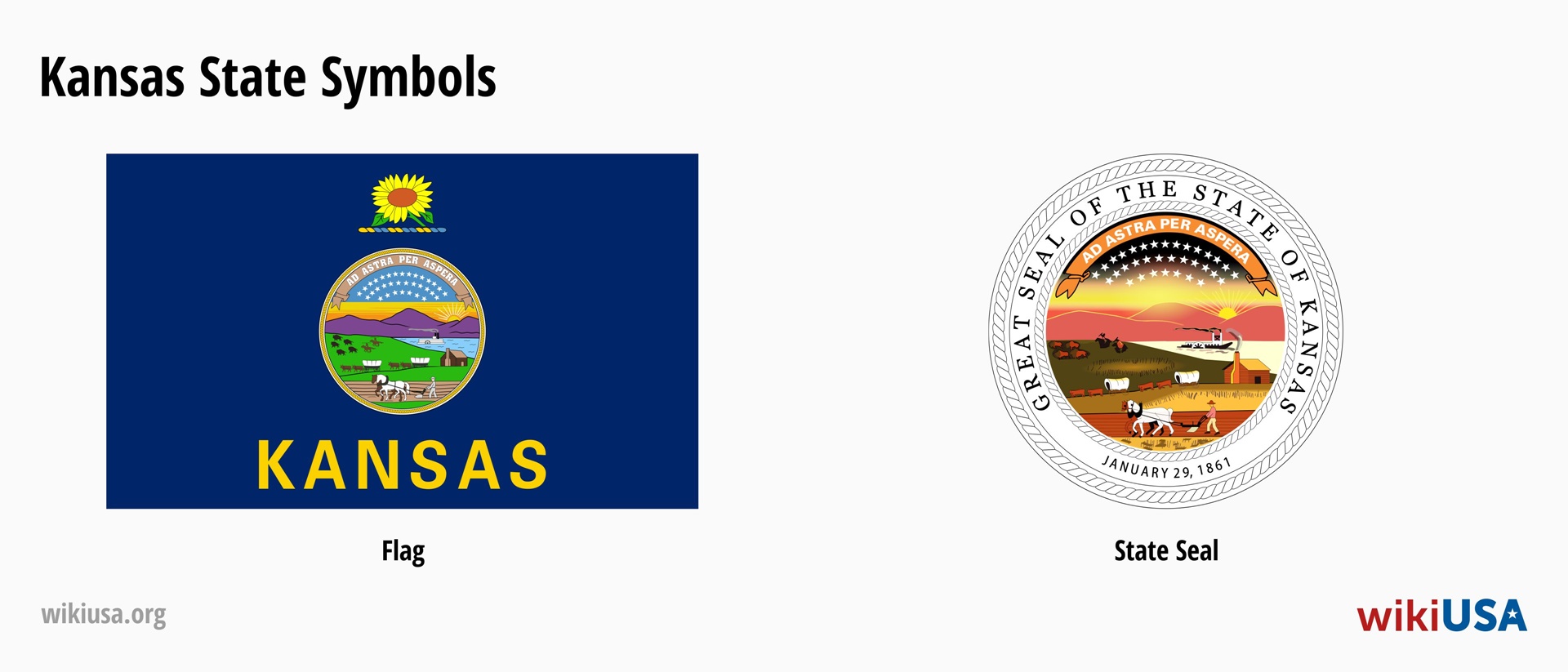
Kansas State Symbols
Kansas has a number of official state symbols defined in its laws, just a few are listed below.
State Flag of Kansas
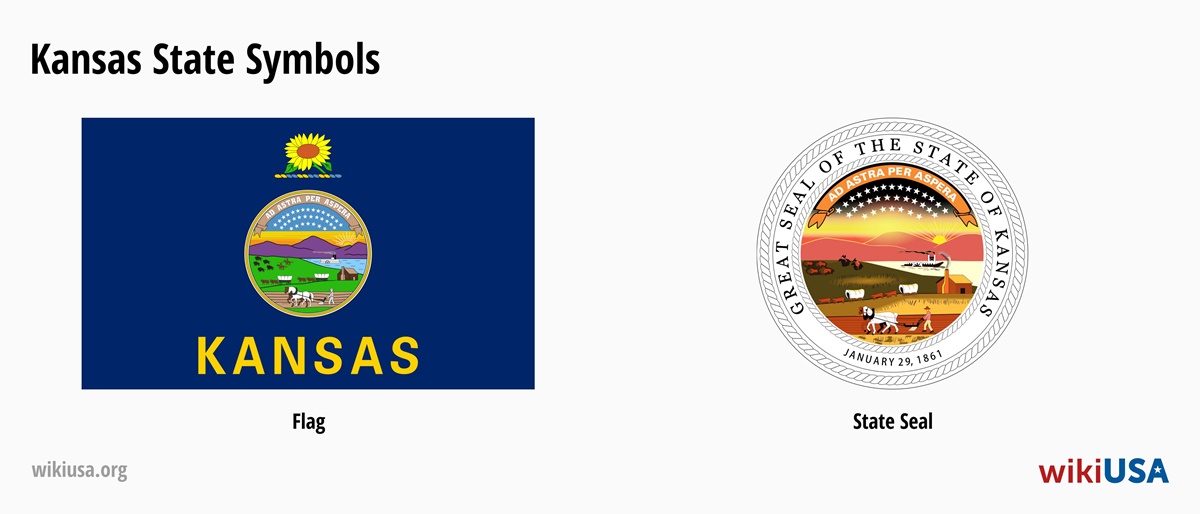
The Kansas flag was adopted in its current form on September 24, 1961. The flag with a dark blue field with the state seal and sunflower is from the original 1928 design, which added the state name at the bottom.
Great Seal of Kansas
The Great Seal of the State was adopted on May 25, 1861, after Kansas became a member of the Union. The seal bears several motifs intended to represent the history of the state. The landscape with the rising sun represents the east, the river and steamboat symbolize commerce, the settler’s cabin and man refer to agriculture, the wagon train heading west recalls early settlers, and there are Indians and buffalo. The number of stars refers to the fact that Kansas became the 34th member of the Union.
State Flower
The official flower of Kansas since 1903 is the sunflower, which can be seen in fields across the state.
State Bird
The state symbols include the western meadowlark (Sturnella neglecta), a long brownish-yellow bird 22 cm was chosen by a vote of elementary school children in 1937.
State Tree
In 1937, the eastern cottonwood (Populus deltoides) was chosen as the state tree of Kansas. The cottonwood is a fast-growing tree with an annual growth rate of up to 8.0 ft, and a total height of up to 100.0 ft.
State Animal
The American bison (Bison bison) was chosen as the animal symbol of Kansas in 1955, and about 200,000 individuals live in parks, preserves, and other open areas in Kansas.
State Reptile
The official reptile of Kansas was established by law in 1986 as the western box turtle (Terrapene ornata), which can grow to 20 cm and can live to be 100 years old. The turtle can be spotted in grassy landscapes near water in most states in the central region of the United States.
State Fish
In 2018, lawmakers added the channel catfish (Ictalurus punctatus), which is commonly found in rivers, ponds and lakes throughout the eastern United States, to the list of state symbols.
State Mineral
As of 2018, the state symbol of Kansas is the mineral galena, which is characterized by its metallic lustrous color and cubic system.
State Fruit
Kansas also thinks about fruit trees, the official symbol since 2022 is the Chickasaw plum (Prunus angustifolia), which was cultivated by the native inhabitants before the arrival of Europeans.



Contribute with Your Question or Personal Experience