
 10 Best Photo Places in the USA
Nebraska (NE) is an agricultural state in the American Midwest, the main crops are corn and soybeans. The local economy is driven by the food industry, with Nebraska being one of the largest processors of beef and pork. The capital is Lincoln and the largest city is Omaha. Major tourist attractions include the Museum of American Speed in Lincoln, one of the largest automobile museums in the USA.

-
Table of Contents
Quick Facts
Name Nebraska Abbreviation NE Capital Lincoln Largest city Omaha (Population: 483 335) Current time 9:52 Time zone CST (UTC-6) is in effect in most of the state, MST (UTC-7) is in effect in the western tip. The state observes daylight saving time CDT (UTC-5) and MDT (UTC-6) Population 1,961,965 (#37 most populous US state) Area 77,358 sqmi (#16 largest US state) Admitted to the Union March 1, 1867 (#37 state to join) ⭐ Capital of Nebraska
The capital of Nebraska is Lincoln, which was founded in 1859 under the name Lancaster. It was declared the capital in 1867, when it was simultaneously renamed in honor of the 16th President of the United States, Abraham Lincoln.
🏙️ Largest City in Nebraska
The largest city in Nebraska is Omaha, with a population of 483,335 in 2023. The second largest city is Lincoln, with 294,757 people, and the third largest is Bellevue, with 63,922 people.
🕒 Time in Nebraska
The current time in Nebraska is 9:52. Central Standard Time (CST, UTC-6) is used throughout most of the state, with only the western tip of the state being governed by Mountain Standard Time (MST, UTC-7). The entire state switches to daylight saving time between March and November.
🧑🤝🧑 Population of Nebraska
As of 2023, Nebraska had a total population of 1,961,965, making it the 37th most populous state in the USA.
📍 Area of Nebraska
Nebraska’s total area is 77,358 sqmi, of which 76,872 sqmi is land and only 481 sqmi is water. Nebraska is the 16th largest US state by area.
-
Fun Facts About Nebraska
🧩 Nebraska Neighboring States
Nebraska is bordered by six American states. Wyoming to the west, South Dakota to the north, Iowa to the east, Missouri to the southeast, Kansas to the south, and Colorado to the southwest.
📅 Date of Nebraska Statehood
Nebraska was admitted to the Union on March 1, 1867 as the 37th state in the order, the precursor to the independent state being the Territory of Nebraska.
📛 Nickname of the State of Nebraska
Nebraska is nicknamed “The Cornhusker State”, referring to the large amount of corn traditionally produced in the state. The term “cornhusker” refers to a person or machine that removes the husks from the corn cob. The term “Cornhusker” is used in Nebraska to refer to sports teams and can also be found on car license plates.
⛰️ Highest Mountain in Nebraska
Nebraska’s highest point is with 5,432 ft Panorama Point, which lies close to the border with Wyoming and Colorado.
🏞️ Rivers in Nebraska
The longest river in Nebraska is the Missouri River with a total length of 2,341 mi. The next longest rivers are the North Platte River (716 mi), the White River (578 mi), the Niobrara River (568 mi), and the Republican River (453 mi).
🎓 Universities in Nebraska
Most students attend the University of Nebraska, with around 52,000 students enrolled in several campuses combined. The university was founded in 1869 and has its main campus in the city of Lincoln. Bellevue University is second with around 12 thousand students, and Concordia University is also significant, with around 3 thousand students enrolled.
✉️ Nebraska ZIP Codes
The state of Nebraska has dedicated zip code ranges 680xx-681xx and 683xx-693xx. You can search for a specific ZIP code on the USPS website, see the article ZIP Codes in the USA for information on how they work.
-
Weather in Nebraska
The best time to visit Nebraska is autumn, when temperatures are pleasant and rainy days are few and far between.
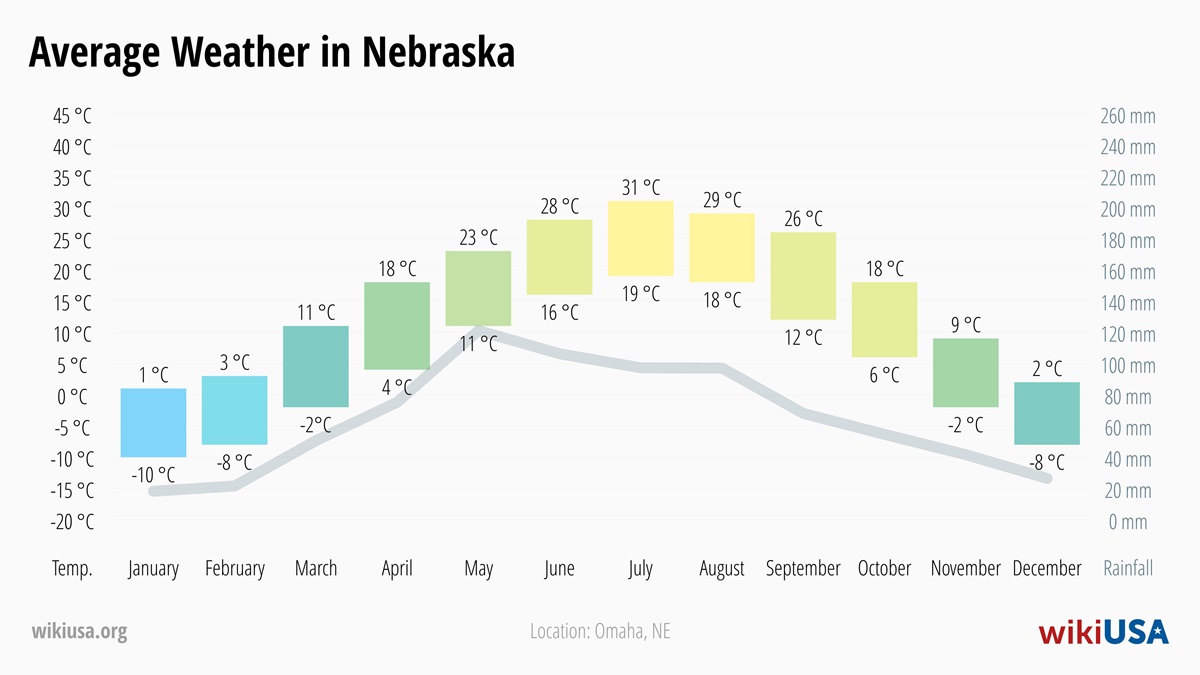
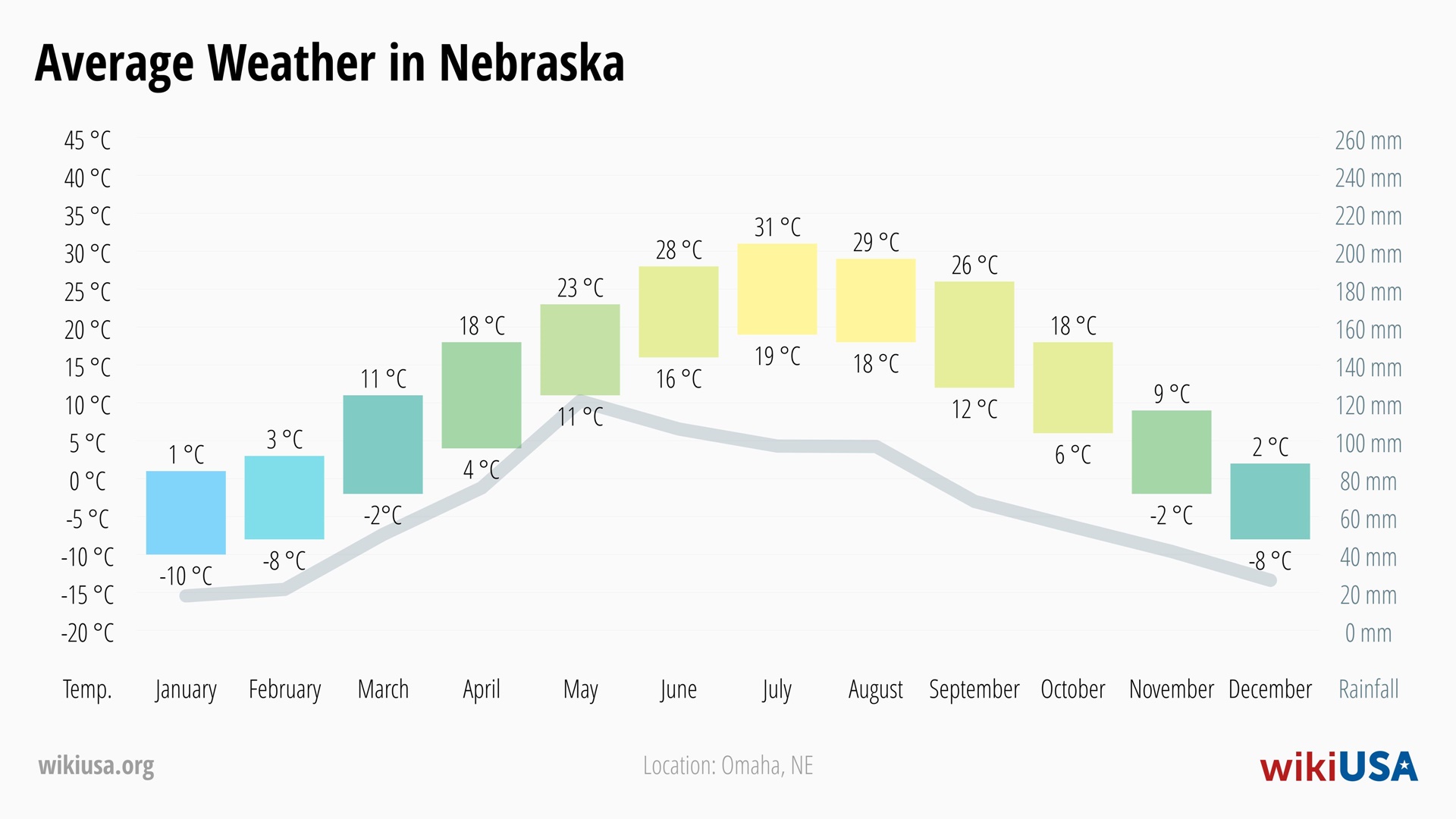
Spring in Nebraska is characterized by changeable weather with frequent transitions between cool and warm days. While temperatures in March range between 28 °F and 52 °F, in May they usually rise to 52 °F to 73 °F. Rainfall is very frequent, with the heaviest rainfall in May, so this time of year is not one of the most popular among tourists. In April and May in particular, there is a significant risk of tornadoes.
Summers in Nebraska tend to be humid and hot, with daytime temperatures from June to August ranging between 73 °F and 88 °F. Heavy thunderstorms are frequent and may be accompanied by torrential rain. Tornadoes are still a risk, but are less frequent compared to the spring months.
Autumn in Nebraska lasts from September to November and is usually mild in terms of temperature. In September, temperatures range between 54 °F and 79 °F, cooling down over time to November’s 28 °F to 48 °F. The rainfall gradually stops, making autumn the best season for hiking and exploring the beauty of nature.
Winter in Nebraska is freezing, with temperatures in December and January ranging between 14 °F and 36 °F. The feeling of cold is made worse by strong winds. Snowfall is frequent, especially in the north of the state, where up to 30 cm snow can fall per month.
🌡️ Average Temperatures and Precipitation in Nebraska
-
Things to Do in Nebraska
1️⃣ Indian Cave State Park
Indian Cave State Park is located on the banks of the Missouri River on the southeastern edge of the state. The park is known for its large cave with prehistoric petroglyphs that can be viewed from a wooden walkway. A popular attraction is the partially reconstructed 19th-century village. The park has around 22 mi miles of hiking and biking trails.
2️⃣ Carhenge
Carhenge is a replica of the iconic Stonehenge monument, but it is not made of stone, but of old cars spray painted gray. Made up of 39 classic American cars from 1951 to 1986, Carhenge was built in 1987 by Jim Reinders in honor of his father. You can visit the rather bizarre attraction in the town of Alliance in western Nebraska, just get off the highway.
3️⃣ Scotts Bluff National Monument
The Scotts Bluff group of rock formations served as an important landmark in the days when native settlers were heading further west in America. Between 1843 and 1869 alone, a quarter of a million emigrants passed through and around Scotts Bluff.
The unique site has been a historic site since 1919, and visitors can view it from several hiking trails, some of which lead to the top of the bluff. The national monument includes a visitor center that provides information about the history of the site.
4️⃣ SAC Aerospace Museum
This highly rated museum in Ashland is dedicated to the history of aviation and space exploration. The museum has an extensive collection of aircraft, including World War II bombers, modern fighters and space rockets.
Among the most interesting exhibits are the Boeing B-52 Stratofortress from the 1950s or the invisible Lockheed F-117A. The museum includes interactive displays and simulators suitable for visitors of all ages.
5️⃣ Smith Falls State Park
Smith Falls State Park is located in the northern part of the state near the South Dakota border and is home to the tallest waterfall in Nebraska, where water falls from 70.0 ft. The waterfall can be reached by a short trail. The area around the Niobrara River is popular for its good selection of hiking trails, campgrounds, or kayaking opportunities.
6️⃣ The Old Market District in Omaha
The Old Market District is a historic neighborhood in the state’s largest city that is filled with restaurants, shops and galleries. As the name implies, the district originally served as a farmers market. Today, historic buildings, cobblestones and pretty courtyards are reminders of a bygone era. The Old Market District is a frequent venue for farmers’ markets, art exhibitions and other cultural events.
7️⃣ Henry Doorly Zoo & Aquarium
The Omaha Zoo and Aquarium is repeatedly ranked among the best in the world, and is known for its strong commitment to animal conservation. The zoo was founded in 1894 under the name Riverview Park.
Today it bears the name of Henry Doorlye, the longtime publisher of the Omaha World-Herald, whose wife made a generous donation to keep the garden running. Nearly 1,000 different species of animals can be seen at the zoo, which is housed in themed pavilions such as a rainforest, polar world, underwater tunnel and desert habitat.
8️⃣ Museum of American Speed
The well-regarded Museum of American Speed is located in Lincoln and is dedicated entirely to the history of American racing and sports cars. The rich collection ranges from the 1920s to the present day. Among the exhibits are cars by legendary builder Darryl Starbird, Herzog Motorsports race cars, motorcycles, go-karts and hot rods.
9️⃣ Nebraska State Capitol
The buildings in the state capital of Lincoln are among the most architecturally significant state chapters in the United States. The building combines Neo-Byzantine, Art Deco and Neo-Gothic styles and was built between 1922 and 1932.
Its height 400 ft makes the building highly visible from much of the city, and its interiors are richly decorated with mosaics and frescoes. Visitors to the Capitol can ascend to the observation deck at 246 ft and take in the views of the surrounding area.
🔟 Chimney Rock National Historic Site
Chimney Rock is a very distinctive rock that rises 299 ft above the surrounding landscape and served as an important landmark for emigrants flowing along the Oregon, California, and Mormon Trails during the settlement of the West. The historic site includes a museum where you can learn more about the history and significance of Chimney Rock.
-
Largest Cities in Nebraska
The table below shows the ten largest cities in the state of Nebraska in 2023, the source of the data is the United States Census Bureau, a federal agency whose primary function is to count the population.
City County Population 1 Omaha Douglas 483,335 Map of Omaha 2 Lincoln Lancaster 294,757 Map of Lincoln 3 Bellevue Sarpy 63,922 Map of Bellevue 4 Grand Island Hall 52,622 Map of Grand Island 5 Kearney Buffalo 34,362 Map of Kearney 6 Fremont Dodge 27,602 Map of Fremont 7 Norfolk Madison 26,147 Map of Norfolk 8 Hastings Adams 24,896 Map of Hastings 9 Columbus Platte 24,464 Map of Columbus 10 Papillion Sarpy 23,791 Map of Papillion -
Sports Teams in Nebraska
🏒 Ice Hockey (NHL)
No team from Nebraska plays in the NHL.
🏈 American Football (NFL)
There is no team from Nebraska in the NFL.
🏀 Basketball (NBA)
There is no team in Nebraska that plays in the NBA.
⚾ Baseball (MLB)
There is no team from Nebraska in the MLB baseball league.
⚽ Soccer (MLS)
Nebraska is not represented in Major League Soccer (MLS).
-

Nebraska State Symbols
The Nebraska state legislature recognizes a number of state symbols, and this article lists some of them.
State Flag of Nebraska
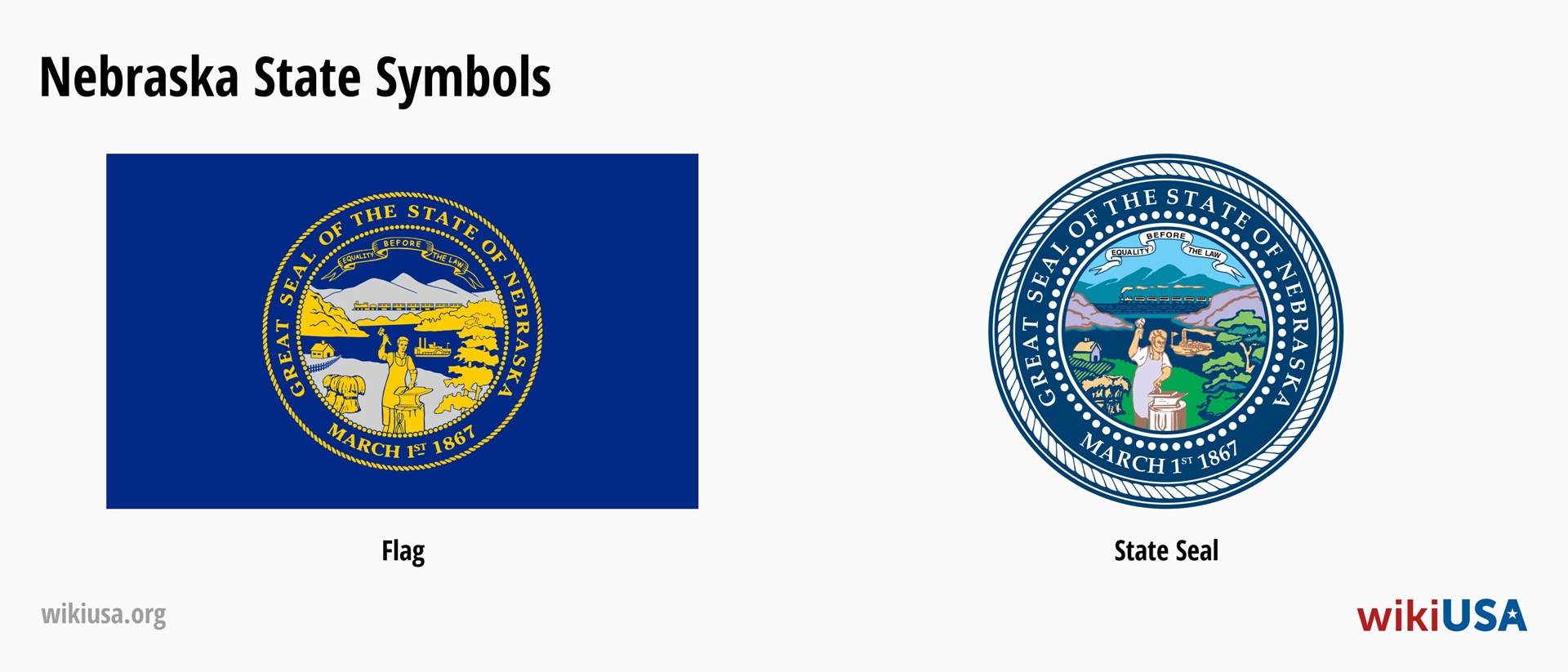
The current flag of Nebraska has been in use since 1925 and consists of the state seal on a dark blue background. Interestingly, Nebraska was one of the last US states to enact an official flag.
Great Seal of Nebraska
The Great Seal has been in use since March 1, 1867, when Nebraska became the 37th state of the United States. The design symbolizes life in Nebraska at the time, with a blacksmith, a steamboat on the Missouri River, and a sheaf of wheat in a landscape with mountains in the background. These all represent industry, agriculture, transportation and the natural beauty of Nebraska.
State Song
The official state anthem since 1960 has been the song Beautiful Nebraska, composed by Jim Fras, who immigrated to the United States from the Soviet Union. The song celebrates the natural beauty and values of Nebraska.
State Tree
Since 1972, the symbol has been the eastern cottonwood (Populus deltoides), which grows along rivers and streams across Nebraska. Some of the trees reach heights of up to 98 ft.
State Bird
In 1929, the western meadowlark (Sturnella neglecta), which is abundant on the Nebraska prairies, was declared the official bird of Nebraska. The wetland warbler is about 22 cm long and is known for its melodious song.
State Fish
The channel catfish (Ictalurus punctatus) became the official state fish in 1997 and is commonly found in Nebraska’s rivers and lakes. It is popular with anglers for its good taste.
State Gem
The blue agate was added to the list of state symbols in 1967 and is relatively common in the prairies of Nebraska. The gem is prized for its deep blue color and is made into jewelry.
State Mammal
Nebraska declared the white-tailed deer (Odocoileus virginianus), which is typical of the local forests and fields, the official state mammal in 1981.
State Drink
In 1998, milk was declared the official state beverage, which was seen as a boost to the local dairy industry, which contributes significantly to Nebraska’s economy.
State Soft Drink
Since 1998, the official soft drink of Nebraska has been Kool-Aid powder, which simply needs water to be poured into it to make sweet lemonade. Kool-Aid powder was developed in 1927 in Hastings, Nebraska, by one Edwin Perkins, who figured out a way to remove the water from fruit concentrate. The original flavors of Kool-Aid were lemon and lime, cherry, orange, grape, raspberry and strawberry.



Contribute with Your Question or Personal Experience