
 10 Best Photo Places in the USA
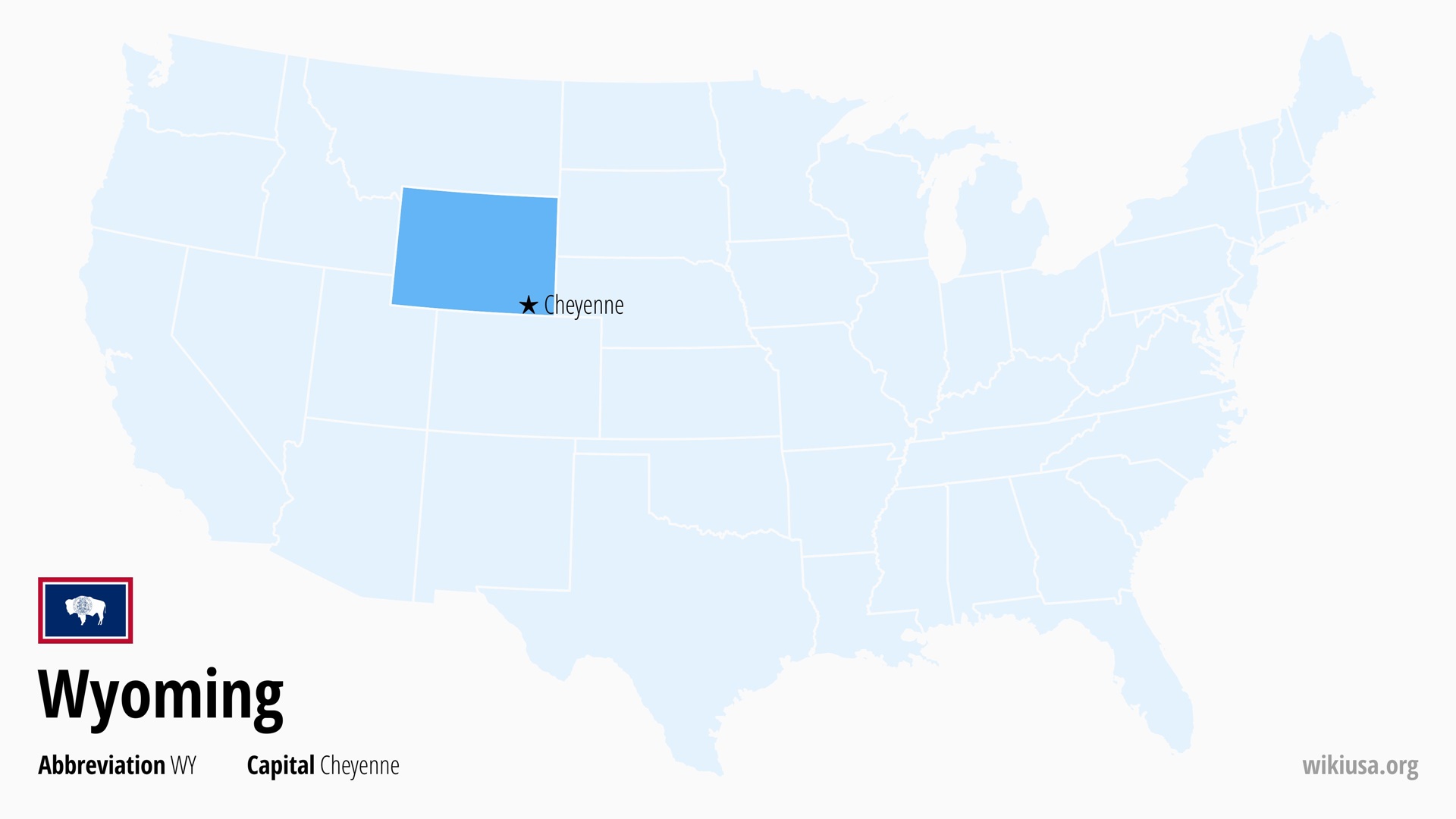
Wyoming (WY) is located in the western United States and has the lowest population of any US state. Two-thirds of Wyoming is covered by mountains and plateaus, and tourists can admire the magnificent wild west nature in Yellowstone and Grand Teton National Parks. Oil, gas and coal production are important to the state’s economy. Wyoming’s capital and largest city is Cheyenne.
-
Table of Contents
Quick Facts
Name Wyoming Abbreviation WY Capital Cheyenne Largest city Cheyenne (Population: 65 168) Current time 3:52 Time zone MST (UTC-7), the state observes Daylight Saving Time MDT (UTC-6) Population 576,850 (#50 most populous US state) Area 97,818 sqmi (#10 largest US state) Admitted to the Union July 10, 1890 (#44 state to join) ⭐ Capital of Wyoming
The capital of the state of Wyoming is Cheyenne. Its history began on July 5, 1867, when the Union Pacific Railroad announced its intention to build its headquarters here. The new residents named the settlement Cheyenne in honor of the Cheyenne Indian tribe that inhabited the area. Cheyenne became the capital of Wyoming Territory in 1869, and after its admission to the Union in 1890, it became the capital of the newly admitted state.
🏙️ Largest City in Wyoming
The largest city in Wyoming is Cheyenne, with a total population of 65,168 in 2023. The second most populous city is Casper with a population of 58,720 and the third largest city is Gillette with a population of 33,796.
🕒 Time in Wyoming
The current time in Wyoming is 3:52. Mountain Standard Time (MST, UTC-7) is in effect throughout the state, switching to Daylight Saving Time MDT (UTC-6) from March to November each year.
🧑🤝🧑 Population of Wyoming
In 2023, Wyoming had a population of only 576,850, ranking it 50th among all US states in terms of population.
📍 Area of Wyoming
Wyoming’s total area is 98 sqmi, of which 97,092 sqmi is land and only 721 sqmi is water. Wyoming is the 10th largest US state.
-
Fun Facts About Wyoming
🧩 Wyoming Neighboring States
Wyoming borders six states. Idaho to the west, Montana to the north, South Dakota and Nebraska to the east, Colorado to the south and Utah to the southwest.
📅 Date of Wyoming Statehood
Wyoming was admitted to the Union on July 10, 1890 as the 44th state in the order, its predecessor being the Wyoming Territory.
📛 Nickname of the State of Wyoming
Wyoming’s official nickname is “The Equality State,” emphasizing the importance of equal rights in the state. Wyoming was the first state to give women the right to vote and hold elected office in 1869. In 1924, Nellie Ross became the first woman in the United States to be elected governor.
The unofficial nickname “The Cowboy State” recalls Wyoming’s long history as a place associated with cattle ranching and cowboy culture in general. The nickname was most popular during the 19th century, when Wyoming was one of the major cattle ranching centers in the United States.
⛰️ Highest Mountain in Wyoming
The highest mountain in Wyoming is Gannett Peak, standing at 13,809 ft, which is part of the Wind River Range. The mountain was named in 1906 after American geographer Henry Gannett, who is considered the father of American cartography.
🏞️ Rivers in Wyoming
The longest river in Wyoming is the Snake River with a total stream length of 1,078 mi. It is followed by the Green River 727 mi, the North Platte River (720 mi), the Yellowstone River (692 mi), and the Niobrara River (568 mi).
🎓 Universities in Wyoming
The largest university in the state is the University of Wyoming, which was founded in 1886 and has its campus in Laramie. It is attended by over 11,000 students and the official colors of the university are brown and gold.
✉️ Wyoming ZIP Codes
The state of Wyoming has dedicated zip code ranges 820xx-831xx and 834xx. You can find out the ZIP code by any address on the USPS website, for more information see the article ZIP Codes in the USA.
-
Weather in Wyoming
The best time of year to visit Wyoming is summer, when pleasant temperatures encourage hiking and visiting the national parks.
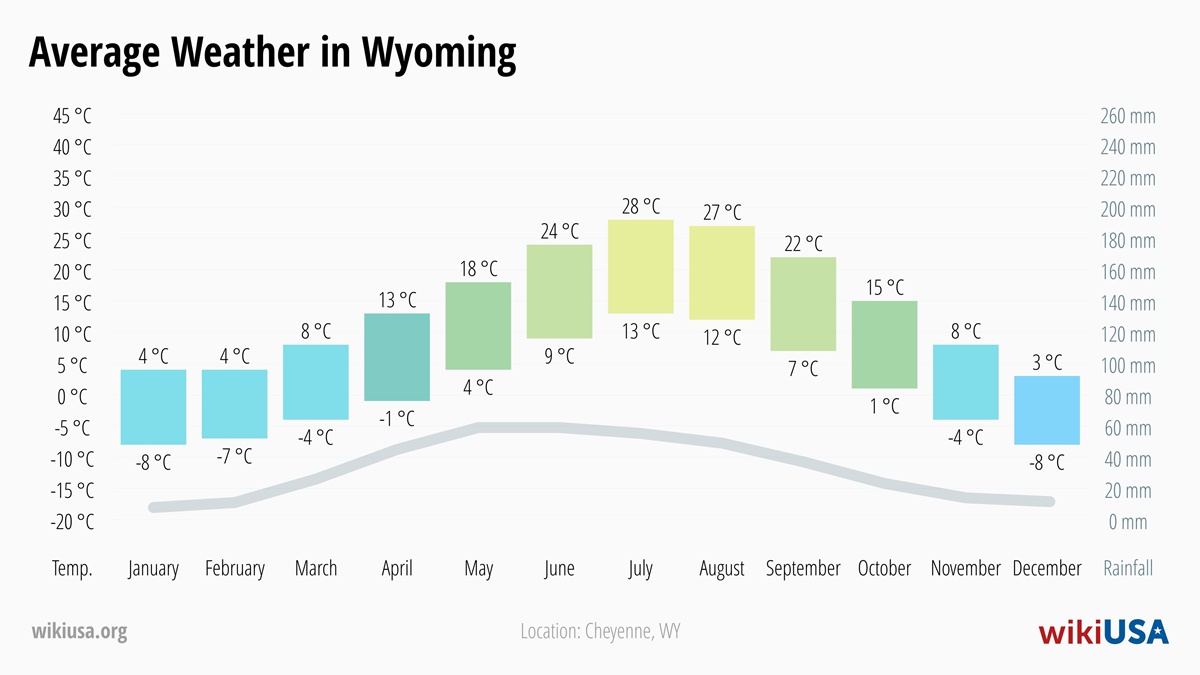
Springtime in Wyoming is usually marked by variable weather, with temperatures typically ranging between 28 °F and 43 °F. Snow melts at lower altitudes and can cause flooding in some areas. At higher altitudes the snow cover is still holding, which negatively affects the accessibility of some hiking trails. Rainfall is also increasing as spring progresses.
Summer in Wyoming brings pleasant temperatures that range between 59 °F and 77 °F. It tends to be warmer at lower altitudes, with the lower limit in mountainous areas. Occasional thunderstorms can occur in the afternoon, but summer is the best time to travel.
Autumn in Wyoming is characterized by unstable weather and falling temperatures. While in September they hover around 50 °F to 66 °F, in November they drop to 25 °F–46 °F. Rainfall is usually minimal.
Winters in Wyoming are long and cold, with temperatures usually staying below freezing at 18 °F–32 °F. The harsh cold is worsened by strong winds. Snowfall is not frequent in the lowlands, but in mountainous areas it can snow up to 250 cm.
🌡️ Average Temperatures and Precipitation in Wyoming
-
Things to Do in Wyoming
1️⃣ Yellowstone National Park
Yellowstone National Park was the very first in the world, established on March 1, 1872. The park is famous for its geothermal phenomena, and its biggest attraction is the Old Faithful geyser, which regularly spews water to an average height of 144 ft.
Yellowstone spans three states, and visitors can admire the park’s spectacular surroundings from more than 900 mi hiking trails. The animal kingdom is also rich, with grizzly bears, bison, wolves, coyotes and mountain lions among its most interesting representatives.
2️⃣ Buffalo Bill Center of the West
The Buffalo Bill Center of the West is a complex of five museums in Cody, near Yellowstone, dedicated to the culture and history of the American West. The museums offer fascinating insights into Native American cultures, Wild West nature and art, firearms, and the life of legendary adventurer Buffalo Bill. The museum features interactive exhibits and demonstrations suitable for all ages.
3️⃣ Grand Teton National Park
Grand Teton National Park in northwest Wyoming is characterized by high mountains and wildlife. The park lies in the Teton Range, whose highest mountain is (prepare for a big surprise) Grand Teton with an elevation of 13,776 ft.
Visitors enjoy ideal conditions for hiking, climbing, camping, and wildlife watching. You can spot herds of bison, wapiti, elk, bears or pronghorn. Grand Teton is south of Yellowstone, and both parks are often visited in one trip.
4️⃣ Devils Tower National Monument
The monumental rock formation of Devils Tower, standing 866 ft high, rises above the rolling landscape. The tower is a sacred site for Native Americans, and today it is a popular destination for climbers, and the tower can be circumnavigated by hiking trails.
Minimal light smog makes it a popular spot for stargazing. Devils Tower is the first U.S. National Monument, having been designated by President Theodore Roosevelt on September 24, 1906.
5️⃣ Cheyenne Frontier Days
Cheyenne Frontier Days is the largest western and outdoor rodeo festival in the world, always held in July. The festival includes rodeo competitions, country concerts, parades and other traditional western activities.
Visitors can see an Indian village, a traditional parade, or have fun at the amusement park. The first festival was held in 1897, and even those not familiar with the western will enjoy the experience.
6️⃣ Hot Springs State Park
Hot Springs State Park is located in the town of Thermopolis and is known for its thermal springs, which produce water at a constant temperature 135 °F. Visitors can enjoy bathing in the healing mineral waters at the local spa, where the water temperature is artificially lowered to a more comfortable 104 °F. The park’s surroundings can be explored along hiking trails from which herds of bison can be observed.
7️⃣ Wind River Mountains
The Wind River Range offers perhaps the very best conditions for alpine hiking and climbing in all of Wyoming. There are several mountains in the area with elevations over 9,843 ft, including Gannett Peak, which is the highest peak in Wyoming with 13,809 ft. The hiking trails offer beautiful views of lakes, glaciers, and wildlife. There are also good conditions for camping in the wilderness.
8️⃣ Fossil Butte National Monument
This area in southwest Wyoming is known for exceptionally well-preserved fossils of fish, plants, and other animals from the Eocene period 34 to 56 million years ago. You can visit the Fossil Butte Monument in person and read more about the fossils on a hiking trail with informational signs. During the summer season, special tours and programs complement them.
9️⃣ Jackson Hole Valley
The picturesque Jackson Hole Valley is surrounded by mountains near Grand Teton National Park, known as a paradise for skiers and nature lovers. Popular summer activities include hiking and rafting, while downhill and cross-country skiing are popular in the winter. The town of Jackson provides the necessary facilities with shops and restaurants.
🔟 National Elk Refuge
The National Elk Refuge is a protected area near the Idaho border that serves as a winter refuge for thousands of elk. During the winter months, visitors can take sleigh rides and observe elk herds up close. Other animals such as coyotes, bison, swans and eagles can also be spotted. For more information on elk migration or ecology, stop by the visitor center.
-
Largest Cities in Wyoming
The table below shows the ten largest cities in the state of Wyoming in 2023, the source of the data is the United States Census Bureau, a federal agency whose main task is to count the population.
City County Population 1 Cheyenne Laramie 65,168 Map of Cheyenne 2 Casper Natrona 58,720 Map of Casper 3 Gillette Campbell 33,496 Map of Gillette 4 Laramie Albany 32,152 Map of Laramie 5 Rock Springs Sweetwater 22,954 Map of Rock Springs 6 Sheridan Sheridan 19,543 Map of Sheridan 7 Evanston Uinta 11,807 Map of Evanston 8 Green River Sweetwater 11,496 Map of Green River 9 Riverton Fremont 10,923 Map of Riverton 10 Jackson Teton 10,639 Map of Jackson -
Sports Teams in Wyoming
🏒 Ice Hockey (NHL)
There are no teams from Wyoming in the NHL.
🏈 American Football (NFL)
There is no team from Wyoming in the NFL.
🏀 Basketball (NBA)
No team from Wyoming plays in the NBA.
⚾ Baseball (MLB)
There is no team in Wyoming that plays MLB.
⚽ Soccer (MLS)
Wyoming is not represented in the MLS soccer league.
-
Wyoming State Symbols
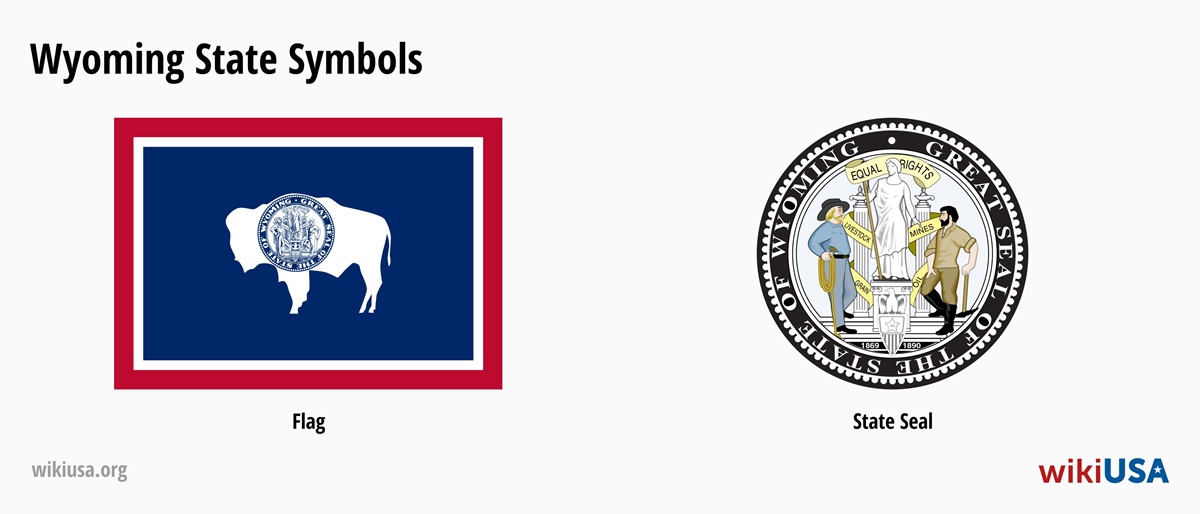
Wyoming has a number of state symbols defined in its laws, here are some of them.
State Flag of Wyoming
The state flag officially began to be used on January 31, 1917, after the Governor of Wyoming signed the appropriate law. The base of the flag consists of a dark blue field bordered by white and red. In the center of the blue field is a white bison, which represents the local fauna. In the middle of the bison is the Wyoming state seal.
Great Seal of Wyoming
The design of the Wyoming State Seal was approved on May 10, 1893 and subsequently underwent minor changes in 1921. The seal depicts a statue of a woman wearing a ribbon above her head mentioning equal rights. Wyoming was the first US state to give women the right to vote in 1869. The woman on the seal is accompanied by two male figures representing agriculture and the mining industry.
State Song
The official national anthem became the Wyoming song in 1955. The lyrics were written by Judge Charles E. Winter during his train travels in the summer of 1903, and the music was composed by Earle R. Clemens. The song was chosen for its patriotism as it celebrates the natural beauty and history of Wyoming.
State Bird
The western meadowlark (Sturnella neglecta), commonly found throughout the state, became Wyoming’s bird symbol in 1927. The warbler traditionally heralds the coming of spring with its song, and other American states have adopted it as their symbol.
State Mammal
The official symbol of Wyoming since 1985 has been the American bison (Bison bison), whose likeness is part of the state flag. The bison is closely tied to Wyoming’s history and especially to its native people. It symbolizes the strength, endurance and freedom of the open plains. Numerous herds of bison can be seen in Yellowstone National Park.
State Flower
The Wyoming Indian paintbrush (Castilleja linariifolia) has spread across Wyoming, known for its distinctive flowers in shades of red to orange. Known as the “Indian paintbrush” because of the shape of its flowers, it was used by Native Americans in traditional medicine. It became a national symbol on 31 January 1917.
State Tree
The eastern cottonwood (Populus deltoides) became the state symbol in 1947 at the urging of schoolchildren and their teachers who wanted to highlight the tree’s importance to local ecosystems. The cottonwood commonly grows throughout the state along rivers and streams, growing up to 98 ft.
State Fish
Wyoming’s state fish since 1987 has been the cutthroat trout (Oncorhynchus clarkii), which is one of the native species in the rivers of Yellowstone National Park. The spotted seatrout is of great importance to the state’s recreational fisheries and was chosen as a symbol of the purity of local waters.
State Gem
Wyoming is known for its deposits of high-quality jade, which occurs in an area from the southern end of the Wind River Mountains in the west of the state to the Platte River near Guernsey in the east of the state. Green jade symbolizes the resilience of the state’s residents, and its selection in 1967 was also intended to encourage interest in mining and mineral processing.
State Sport
Rodeo was declared Wyoming’s official state sport in 2003. Wyoming traditionally hosts Cheyenne Frontier Days, one of the largest and oldest rodeo-related events in the world.




Contribute with Your Question or Personal Experience