
 10 Best Photo Places in the USA
North Carolina (NC) is located in the southeastern United States and is known for its diverse landscapes that range from the Appalachian Mountains to the Atlantic coast. The financial sector, along with technology and manufacturing, are the main contributors to the state’s economy. The capital of North Carolina is Raleigh, with the largest population living in Charlotte. Popular tourist attractions include the Great Smoky Mountains National Park and the Outer Banks Archipelago.

-
Table of Contents
Quick Facts
Name North Carolina Abbreviation NC Capital Raleigh Largest city Charlotte (Population: 911 311) Current time 6:44 Time zone EST (UTC-5), state observes Daylight Saving Time EDT (UTC-4) Population 10,439,459 (#9 most populous US state) Area 53,819 sqmi (#28 largest US state) Admitted to the Union November 21, 1789 (#12 state to join) ⭐ Capital of North Carolina
Raleigh has served as the capital of North Carolina since 1794. The decision to build an entirely new capital was made in 1788, and the location was deliberately chosen in the middle of the state to protect it from attacks from the coast. The city’s name was chosen in honor of Sir Walter Raleigh, who was involved in the colonization of America.
🏙️ Largest City in North Carolina
The largest city in North Carolina is Charlotte, with a population of 911,311 in 2023. The second largest city is Raleigh with a population of 482,295 and the third largest city is Greensboro with a population of 302,296.
🕒 Time in North Carolina
The current time in North Carolina is 6:44. Eastern Standard Time (EST, UTC-5) is in effect throughout the state, switching to Daylight Saving Time EDT (UTC-4) between March and November.
🧑🤝🧑 Population of North Carolina
As of 2023, North Carolina had a population of 10,439,459, ranking it as the 9th most populous state in the USA.
📍 Area of North Carolina
The total area of North Carolina is 53,819 sqmi, of which 48,618 sqmi is land and 5,201 sqmi is water. North Carolina is the 28th largest US state.
-
Fun Facts About North Carolina
🧩 North Carolina Neighboring States
North Carolina is bordered by four US states. Tennessee to the west, Virginia to the north, South Carolina to the south, and Georgia to the southwest. In addition, it has a long Atlantic Ocean coastline to the east 301 mi.
📅 Date of North Carolina Statehood
North Carolina ratified the United States Constitution on November 21, 1789, as the 12th state in the order. Its predecessor was the Colony of North Carolina.
📛 Nickname of the State of North Carolina
North Carolina is nicknamed “The Tarheel State”. The phrase “Tar Heel” was used between the 18th and 19th centuries to refer to the poor laborers who made pitch, turpentine, and tar from the pine forests. Originally a rather pejorative term, it became a popular nickname for North Carolina soldiers during the American Revolutionary War.
The other nickname, “The Old North State,” originated in the 17th century, when only one colony, Carolina, existed under British rule. The nickname refers to the historical division of the colonies, which broke up in 1712.
⛰️ Highest Mountain in North Carolina
The highest mountain in North Carolina is with 6,684 ft Mount Mitchell, which is both the highest peak in the Appalachian Mountains and the highest peak lying east of the Mississippi River. The mountain is part of Mount Mitchell State Park, named after University of North Carolina professor Elisha Mitchell, who first mapped the mountains in the region in 1835. Elish Mitchell died in 1857 while attempting to re-survey the mountain.
🏞️ Rivers in North Carolina
The longest river flowing through North Carolina is the Roanoke River, with the total length of flow in all states 410 mi. This is followed by the New River (317 mi), the Neuse River (275 mi), the Pee Dee River (232 mi), and the Catawba River (217 mi).
🎓 Universities in North Carolina
The largest university is North Carolina State University with just under 37 thousand students, founded in 1887 in the city of Raleigh. The next ranks are the University of North Carolina and its two campuses. The older campus in Chapel Hill opened in 1789 and today has an enrollment of just under 32 thousand students. The younger campus in Charlotte has just under 30 thousand students registered and opened in 1946.
Another major university is East Carolina University in Greenville with approximately 27 thousand students, its tradition dates back to 1907.
✉️ North Carolina ZIP Codes
North Carolina has dedicated ZIP codes ranging from 270xx-289xx, searchable by address on the USPS website. For more information and an overview map, see the article ZIP Codes in the USA.
-
Weather in North Carolina
The best time to visit North Carolina is in late spring and early fall, when the weather is very pleasant and with less precipitation than in fall or winter. In the spring, nature is in bloom and in the fall, the deciduous trees turn beautiful shades of orange and red.
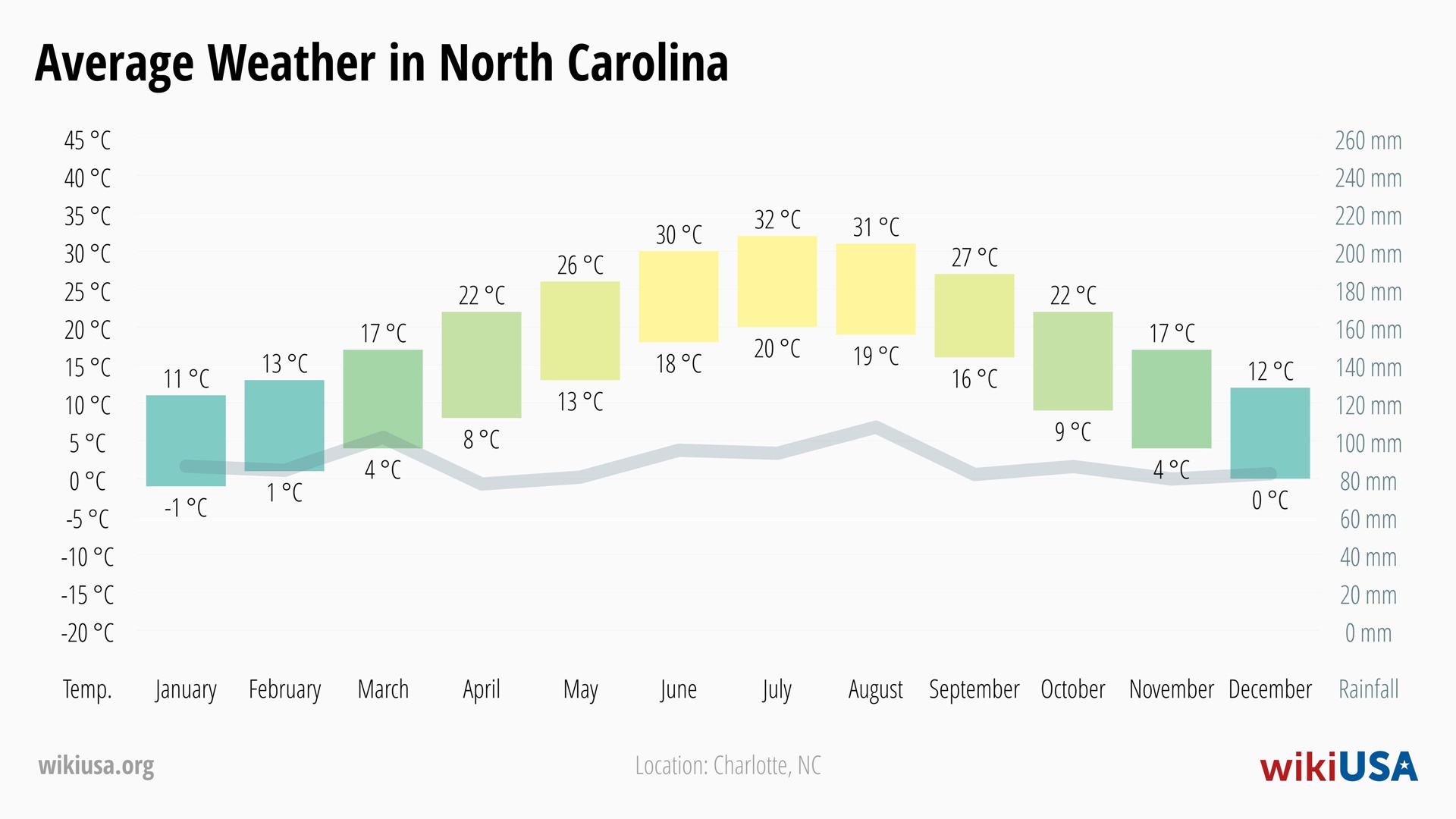
Spring in North Carolina is marked by pleasant temperatures, with March temperatures in the largest city, Charlotte, ranging between 39 °F and 63 °F, gradually warming up to May temperatures of 55 °F to 79 °F. Rainfall is relatively frequent and may be accompanied by thunderstorms from time to time. Snow cover may persist in the mountains and in the western part of the state in early spring as temperatures tend to be cooler.
Summers in North Carolina are humid and hot, especially in the lowlands and Atlantic coastal areas. Temperatures from June to August usually range between 72 °F and 90 °F, and high humidity can add to the feeling of heat. In the summer months, afternoon thunderstorms are common and can be accompanied by heavy rain showers. The mountains in the west of the country are usually cooler, with temperatures around 66 °F–75 °F. In late summer, the risk of a hurricane on the coast increases.
Fall in North Carolina is one of the most beautiful times of the year, thanks to pleasant temperatures and relatively few rainy days. In September, temperatures generally range between 61 °F and 79 °F, gradually dropping to November’s 39 °F to 63 °F. Coastal areas of North Carolina remain at risk from hurricanes through the end of October, but the risk is gradually decreasing.
Winter in North Carolina tends to be mild, with temperatures in the lowlands generally between 32 °F and 50 °F. In the Appalachian Mountains and generally at higher elevations, temperatures can drop below freezing and snowfall can occur. In the lowlands and along the coast, precipitation is mostly rain, and ice storms can occur when temperatures drop sharply.
🌡️ Average Temperatures and Precipitation in North Carolina

-
Things to Do in North Carolina
1️⃣ Great Smoky Mountains National Park
The Great Smoky Mountains are one of the most visited national parks in the USA, located on the border of North Carolina and Tennessee. The park is crisscrossed by a network of more than 800 mi marked hiking trails, including 71.0 mi long stretch of the famous Appalachian Trail.
The national park offers breathtaking views of dense forests and hills that are often shrouded in fog. The animal kingdom is also well represented, with black bears, white-tailed deer, raccoons and marmots living in the Great Smoky Mountains.
2️⃣ Blue Ridge Parkway
The Blue Ridge Parkway is a scenic 469 mi long road that stretches across North Carolina and Virginia along the ridges of the Blue Ridge Mountains. There are a number of rest stops along the road where you can stop and admire unforgettable views of the mountains, forests and waterfalls.
The best time to drive along the Blue Ridge Parkway is in the fall, when the leaves on the trees play with all their colors. The parkway is open year-round, but in the winter some sections may be inaccessible due to snow.
3️⃣ Mount Mitchell State Park
The state park is home to the tallest mountain in the eastern United States, 6,683 ft tall Mount Mitchell. Visitors can follow several hiking trails in the park, such as those through dense spruce forests, offering spectacular views of the surrounding mountains. At the top of Mount Mitchell is a viewing platform with panoramic views of the surrounding landscape
4️⃣ Wright Brothers National Memorial
The Wright Brothers National Memorial is located on the Atlantic coast at the site where the Wright brothers made the first-ever powered airplane flight on December 17, 1903. The Art Deco granite monument complements the visitor center with exhibits that illustrate the story of the pioneering flight that changed the world. A replica of the Wright Flyer is on the grounds.
5️⃣ Tweetsie Railroad Amusement Park
Tweetsie Railroad is a family-friendly amusement park that is styled after the wild American West. The park’s main attraction is a 3.0 mi long narrow gauge railroad with an authentic 1917 steam locomotive that pulls cars across the scenic landscape of the Blue Ridge Mountains. Kids can ride the scenic wheel, pony rides, carousels or the cable car.
6️⃣ Chimney Rock State Park
Located in the western part of the state, Chimney Rock State Park is known for its unmistakable chimney-shaped rock formation, which offers spectacular panoramic views of the surrounding area. Either an elevator or a steep and quite challenging wooden staircase leads to the top of the rock.
There are several other hiking trails in the park, and the reward for climbing them is a view of one of the highest waterfalls in the entire region.
7️⃣ Biltmore Estate
The 250-room Biltmore Estate is the largest private home in the USA, built between 1889 and 1895 by the Vanderbilt family. Architect Richard Morris Hunt designed it in the Châteauesque style, which is based on French Renaissance architecture.
The chateau includes extensive gardens and vineyards, and visitors can taste the wines on the tour. The chateau’s interiors are also open to the public and regularly host summer festivals and other cultural events.
8️⃣ Battleship USS North Carolina
The USS North Carolina is a battleship launched in 1940 that served as an escort to aircraft carriers in the Pacific during World War II. After the end of the war, she served as a training ship for a while and was decommissioned in 1947.
Today, the 728.74 ft battleship is docked in Wilmington and is fully open to visitors as a museum. The interior of the ship, the engine room, the officers’ quarters and the main gun turrets can be viewed. The museum includes an interactive exhibit with an audio guide that provides insight into the history of the ship and her crew.
9️⃣ Grandfather Mountain
At an elevation of 5,946 ft, Grandfather Mountain is one of the highest peaks in the Blue Ridge Mountains. The mountain is famous for the Mile High Swinging Bridge, which is 228 ft long and lies at an elevation of 5,305 ft.
The suspension bridge offers a beautiful view of the surrounding mountains and deep valleys. Several hiking trails of varying difficulty are marked around the park, leading through beautiful forests and rocky peaks.
🔟 Linville Falls
Linville Falls is located in the gorge of the same name, which is called the “Grand Canyon of the East”. The canyon is as deep as 1,400 ft and is surrounded by steep rock walls and dense pine forests. Several hiking trails lead to the waterfall, its total height is 150.0 ft. The best conditions for visiting the falls are in spring and autumn.
-
Largest Cities in North Carolina
The table below shows the ten largest cities in the state of North Carolina in 2023, the source of the data is the United States Census Bureau, a federal agency whose primary function is to count the population.
City County Population 1 Charlotte Mecklenburg 911,311 Map of Charlotte 2 Raleigh Wake, Durham 482,295 Map of Raleigh 3 Greensboro Guilford 302,296 Map of Greensboro 4 Durham Durham, Wake, Orange 296,186 Map of Durham 5 Winston-Salem Forsyth 252,975 Map of Winston-Salem 6 Fayetteville Cumberland 209,749 Map of Fayetteville 7 Cary Chatham, Wake, Durham 180,010 Map of Cary 8 Wilmington New Hanover 122,698 Map of Wilmington 9 High Point Guilford, Davidson, Randolph, Forsyth 116,926 Map of High Point 10 Concord Cabarrus 110,119 Map of Concord -
Sports Teams in North Carolina
🏒 Ice Hockey (NHL)
The only team from North Carolina in the NHL is the Carolina Hurricanes, who play their home games at the Lenovo Center in Raleigh. The team colors are black, red, gray and white. The club is ranked in the Metropolitan Division of the Eastern Conference.
🏈 American Football (NFL)
The Carolina Panthers are the only club from North Carolina that operates in the NFL. They joined in the 1995 season, belonging to the South Division of the NFC Conference. The Panthers play their home games at Bank of America Stadium in Charlotte, the club colors are black, blue and silver.
🏀 Basketball (NBA)
North Carolina’s only representative in the NBA is the Charlotte Hornets of the Southeast Division in the Eastern Conference. The Hornets joined in the 1988 season, choosing blue-green, dark purple, gray and white as their club colors. The team plays its home games at the Spectrum Center in Charlotte.
⚾ Baseball (MLB)
No team from North Carolina plays in the MLB league.
⚽ Soccer (MLS)
North Carolina has been represented in the MLS Soccer League by Charlotte FC since the 2022 season and has been assigned to the Eastern Conference. It plays its home games at Bank of America Stadium in Charlotte. The club colors are royal blue and black.
-
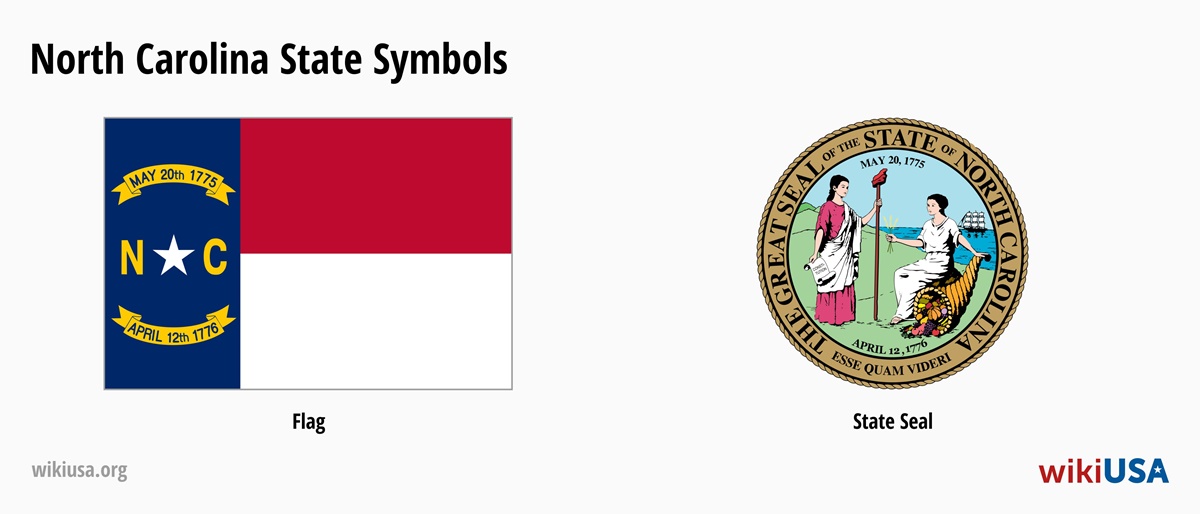
North Carolina State Symbols
North Carolina law defines dozens of official state symbols, and this article lists some of them.
State Flag of North Carolina
The flag of North Carolina has been used in its current form since 1885. It draws attention to it along with the NC state abbreviation by the pair of dates shown on the yellow ribbon.
On the upper ribbon, 20 May 1775 commemorates the day Charlotte declared independence from Great Britain. On the lower ribbon is April 12, 1776, when North Carolina supported the independence of the original thirteen colonies.
Great Seal of North Carolina
The Great Seal of the State of North Carolina has been used in its current design since 1983. The main motif of the seal is the figures of Liberty and Abundance, which symbolize the ideals of the state. The two figures are complemented by green hills and crops, indicating the state’s diverse landscape and natural resources.
State Song
The official anthem of North Carolina is the 1835 composition The Old North State, written by lawyer and politician William Gaston. The song was chosen for its patriotic lyrics that celebrate the beauty and richness of the state. It became the national anthem in 1927.
State Tree
The symbol of North Carolina is the pine tree (Pinus), which is a widespread species and plays an important role in the state’s timber industry. In the past, pine resin was an important material for shipbuilding.
State Flower
Since 1941, the state flower is the flowering dogwood (Cornus florida), a white-flowered plant commonly found along the eastern seaboard of the United States. For North Carolinians, the dogwood is a symbol of strength and elegance.
State Mammal
Since 1969, the state’s symbols have included the eastern gray squirrel (Sciurus carolinensis), which is commonly found in North Carolina’s city parks and countryside. The squirrel was chosen as a symbol of resilience and adaptability to reflect the character of the state’s residents.
State Reptile
North Carolina’s official reptile since 1979 has been the eastern box turtle (Terrapene carolina carolina); individuals can live to be more than 100 years old in the wild. The turtle was chosen for its symbolism of longevity, endurance, and patience.
State Vegetable
In 1995, sweet potatoes became the official vegetable, the cultivation of which plays an important role in the state’s agriculture. North Carolina is one of the main producers of sweet potatoes in the USA, and the vegetable is part of the region’s traditional foods.
State Stone
Granite was declared the official stone of North Carolina in 1979, and the state is one of the top states in the United States for quarrying and processing this stone. The town of Mount Airy, near the Virginia border, is home to the largest open-pit granite quarry in the world.
State Colors
A 1945 law establishes red and blue as the state colors in the shades used on the North Carolina flag and the American flag.




Contribute with Your Question or Personal Experience