
 10 Best Photo Places in the USA
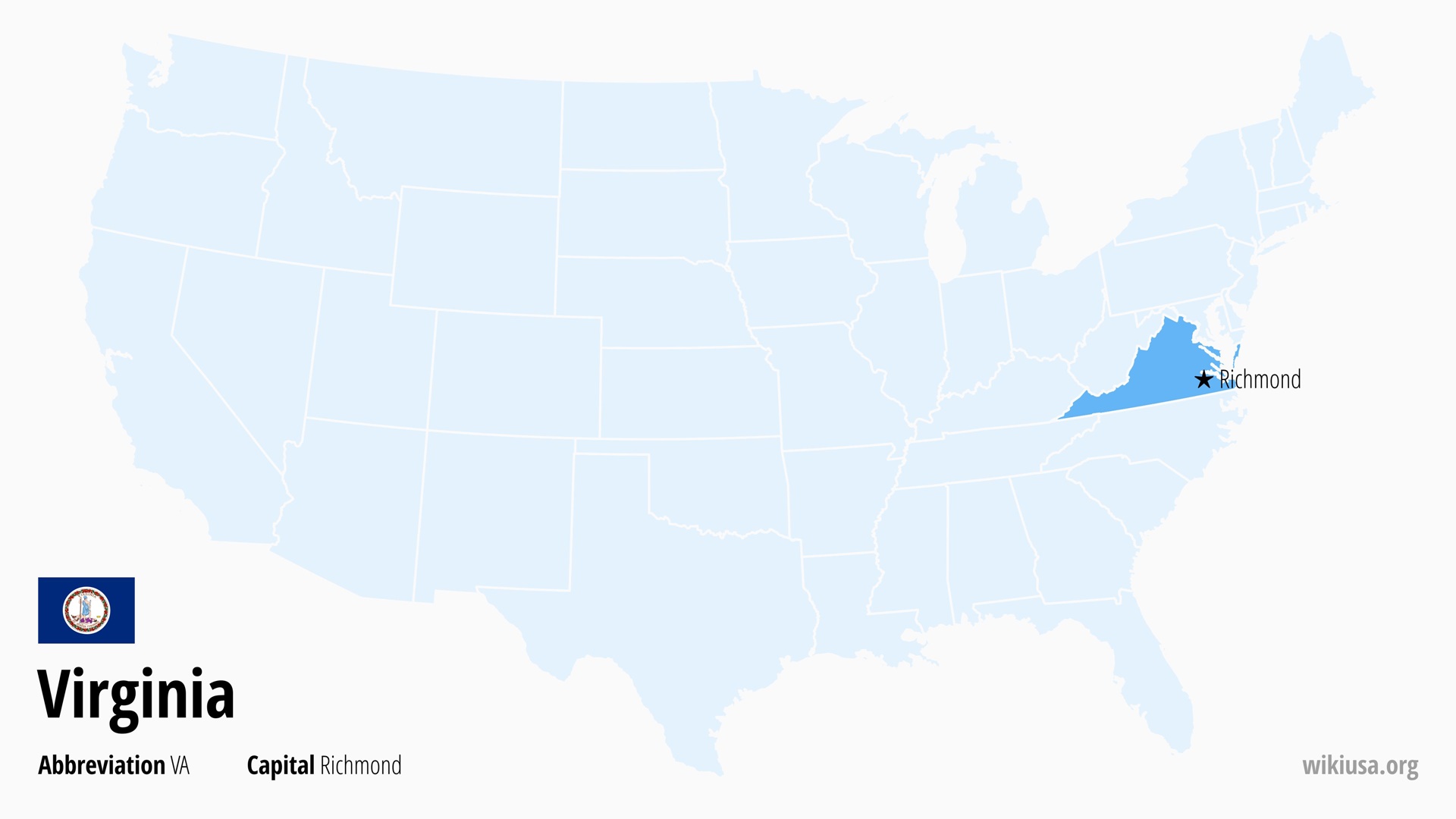
Virginia (VA) is located on the eastern seaboard, the state has a rich colonial past and played a significant role in the formation of the USA. The technology sector and military presence are important for Virginia’s economy, complemented by agriculture. Major tourist attractions include Shenandoah National Park and Arlington National Cemetery. The capital of Virginia is Richmond, but the most populous city is Virginia Beach.
-
Table of Contents
Quick Facts
Name Virginia Abbreviation VA Capital Richmond Largest city Virginia Beach (Population: 453 649) Current time 18:46 Time zone EST (UTC-5), the state observes Daylight Saving Time EDT (UTC-4) Population 8,631,373 (#12 most populous US state) Area 42,775 sqmi (#35 largest US state) Admitted to the Union June 25, 1788 (#10 state to join) ⭐ Capital of Virginia
The capital of Virginia is Richmond, which was founded in an already settled area in 1742 by planter William Byrd II. He had commissioned civil engineer William Mayo five years earlier to lay out plans for the city’s construction.
The name was chosen after the then town of Richmond in England, which is now a London borough. Richmond became the capital of Virginia on April 18, 1780, when it succeeded Williamsburg.
🏙️ Largest City in Virginia
The largest city in Virginia is Virginia Beach, with a total population of 453,649 in 2023. The second most populous city is Chesapeake with a population of 253,886 and the third most populous city is Norfolk with 230,930 residents.
🕒 Time in Virginia
The current time in Virginia is [timezone=”America/New_York” format=”G:i”]. Eastern Standard Time (EST, UTC-5) is in effect throughout the state from November to March, switching to Daylight Saving Time EDT (UTC-4) each time.
🧑🤝🧑 Population of Virginia
Virginia had a population of 8,631,373 in 2023, ranking it 12th on the list of the most populous US states.
📍 Area of Virginia
The total area of Virginia is 42,775 sqmi, of which 40 sqmi is land and 3,180 sqmi is water. Virginia is the 35th largest US state.
-
Fun Facts About Virginia
🧩 Virginia Neighboring States
Virginia is bordered by five US states and Washington D. C. Kentucky to the west, West Virginia to the northwest, Maryland to the northeast, and North Carolina and Tennessee to the southeast. In addition, it has a long coastline with the Atlantic Ocean to the east 112 mi.
📅 Date of Virginia Statehood
Virginia ratified its entry into the Union on June 25, 1788 as the 10th state in line, its predecessor being the Crown Colony of Virginia.
📛 Nickname of the State of Virginia
Virginia became the first permanent English colony in the New World in 1607, earning the title “The Old Dominion” from then King Charles II for its loyalty and allegiance. The term “Dominion” does not have a literal translation, but refers to the territory under the sovereign possession of England.
The second nickname, “The Mother of Presidents”, refers to the fact that eight different American presidents have come from Virginia, more than from any other US state.
⛰️ Highest Mountain in Virginia
Virginia’s highest mountain is 5,729 ft Mount Rogers, which is located in the southern part of the state near the borders of North Carolina and Tennessee and is part of the Blue Ridge Mountains.
🏞️ Rivers in Virginia
The longest river in Virginia is the Roanoke River, with a total length of 410 mi. It is followed by the James River (348 mi), the New River (317 mi), the Potomac River (302 mi), and the Clinch River (298 mi).
🎓 Universities in Virginia
The largest university in Virginia is Liberty University, founded in 1971 in the city of Lynchburg and today attended by around 79,000 students.
The second largest university is George Mason University from the city of Fairfax, where approximately 37 thousand students are registered. In third place is the Virginia Polytechnic Institute and State University with a tradition dating back to 1872, in the town of Blacksburg in which about 35 thousand people study.
✉️ Virginia ZIP Codes
Zip codes in Virginia have reserved ranges of 201xx and 220xx-246xx, searchable by address on the USPS website. For more information on how the system works, see the article ZIP Codes in the USA.
-
Weather in Virginia
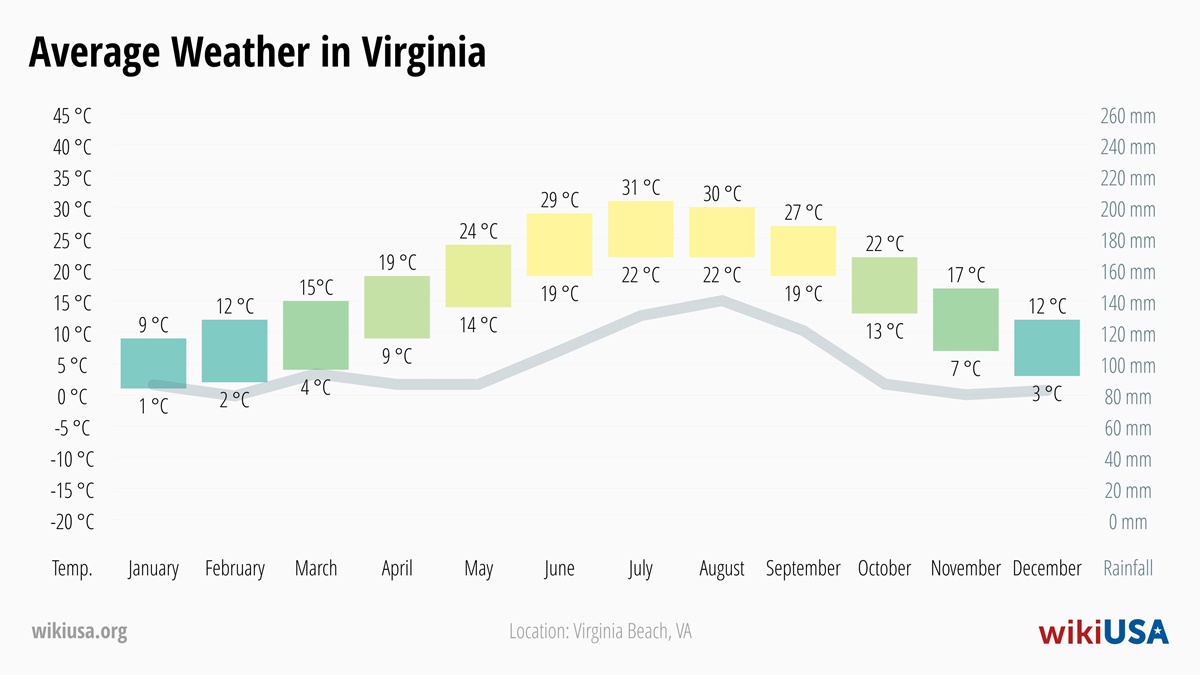
The best time to visit Virginia is early fall, when the countryside is turning beautiful and the weather is still pleasant.
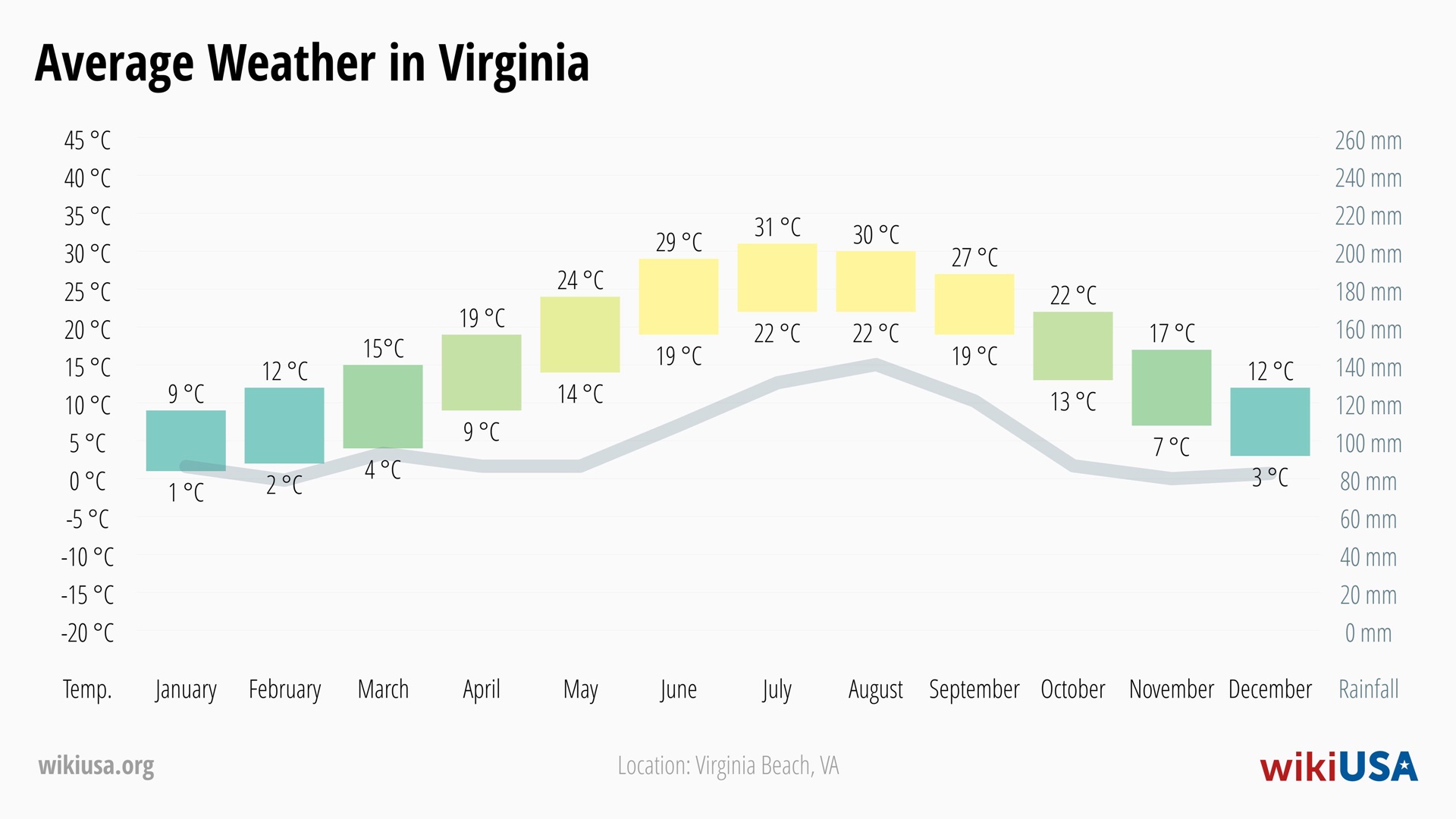
Spring in Virginia tends to be mild, with temperatures gradually rising from March 43 °F to 55 °F to May 61 °F to 72 °F. Frequent and heavy rains are typical for the spring months.
Summers in Virginia are warm and humid, with high temperatures around 75 °F to 86 °F from June to early September. Humid air adds to the temperature sensation, and thunderstorms are frequent in the afternoon and evening.
Autumn in Virginia is mild and dry compared to previous months. Temperatures in September and October range between 63 °F and 75 °F, making conditions favorable for hiking and other outdoor activities.
Winters in Virginia are mild, with temperatures mostly above freezing. The area around Virginia Beach usually experiences temperatures between 37 °F and 48 °F; snow showers are rare at these lower elevations. Snow is more common in the mountains of western Virginia.
🌡️ Average Temperatures and Precipitation in Virginia
-
Things to Do in Virginia
1️⃣ Shenandoah National Park
Shenandoah National Park is located in the Blue Ridge Mountains, in the northern part of the state. Its main attraction is the 105.5 mi long Skyline Drive with several stops that offer spectacular panoramic views of the surrounding countryside.
Hikers can use the park’s 516 mi hiking trails, including part of the popular Appalachian Trail, which runs from Georgia to Maine. The best times to visit Shenandoah National Park are September through November and March through May.
2️⃣ Virginia Beach
Virginia Beach is a city on the Atlantic coast, known for its sandy beaches and 3.0 mi long boardwalk lined with hotels and restaurants. The area is popular for swimming, surfing, kayaking and other water sports. Festivals, concerts and other cultural events are regularly held on the boardwalk, adding to the lively atmosphere of Virginia Beach.
3️⃣ Arlington National Cemetery
The most famous and largest military cemetery in the USA, Arlington National Cemetery was established during the American Civil War and has since buried more than 400,000 fallen soldiers and other notable figures. Among the most famous are former American Presidents John F. Kennedy and William Howard Taft, and soldier William Henry Christman, who on May 13, 1864, became the very first person buried at Arlington.
Visitors can watch the changing of the guards at the Tomb of the Unknown Soldier or view the Eternal Flame monument at President Kennedy’s grave.
4️⃣ Colonial Williamsburg Museum
Colonial Williamsburg is an outdoor museum in the eastern part of the state that provides an authentic glimpse into life in colonial America during the 18th century. The museum features costumed guides who give demonstrations of crafts and daily activities.
Visitors can tour the historic homes, shops and government buildings that were renovated in the early 1930s.
5️⃣ Busch Gardens Amusement Park
Busch Gardens is an amusement park in the city of Williamsburg in eastern Virginia, designed to resemble various European countries in its look and concept. The amusement park attracts visitors with more than fifty attractions, ten of which are thrill rides. Children and fans of slower rides will find their way to the park, making it the perfect all-day entertainment for families.
6️⃣ Virginia Creeper Trail
The Virginia Creeper Trail is a 34.3 mi long multi-use trail in southwestern Virginia that was built on the body of the original railroad line built in the late 19th century. The trail connects the towns of Abingdon and Whitetop, and runs partially over wooden bridges and trestles. It can be traveled on foot, by bicycle, or horseback, and offers beautiful views of the countryside around Mount Rogers.
7️⃣ First Landing State Park
First Landing State Park is located near the site where English colonists from the ship Susan Constant, led by Captain Christopher Newport, first landed on April 26, 1607. The park is located near the town of Virginia Beach and offers visitors around 19.0 mi hiking and biking trails that lead through forests, salt marshes, and cypress swamps.
8️⃣ Mount Vernon Plantation Residence
Mount Vernon was the plantation home of the first President of the United States, George Washington, whose family purchased the surrounding land in 1674. The house, built in the Palladian style with features of the English Georgian style, lies south of Washington, D.C. Today it serves as a museum that provides a detailed look into plantation life during the 18th century.
Visitors can tour the historic mansion, outbuildings, gardens and the grave of George and Martha Washington.
9️⃣ Luray Caverns
Luray Caverns in northern Virginia form the largest cave system on the East Coast of the United States. Visitors can admire the unique stalactite and stalagmite formations and especially the Great Stalacpipe Organ, the largest musical instrument in the world.
The park’s cave organ has stood since 1957 and can play such works as Beethoven’s Moonlight Sonata. Visitors can explore the illuminated caves along cobblestone walkways either on their own or during a guided tour.
🔟 Natural Bridge State Park
The main attraction of the state park is the 215.0 ft high natural limestone arch covered with greenery. Interestingly, the land beneath the arch was purchased from British King George III in 1774 by the late American President Thomas Jefferson. Visitors to the park can walk along the 2.2 mi long Cedar Creek Trail, which passes under the bridge and continues to Lace Falls.
-
Largest Cities in Virginia
The table below shows the ten largest cities in the state of Virginia in 2023, the source of the data is the United States Census Bureau, a federal agency whose main job is to count the population.
City County Population 1 Virginia Beach – 453,649 Map of Virginia Beach 2 Chesapeake – 253,886 Map of Chesapeake 3 Norfolk – 230,930 Map of Norfolk 4 Richmond – 229,247 Map of Richmond 5 Newport News – 183,118 Map of Newport News 6 Alexandria – 155,230 Map of Alexandria 7 Hampton – 137,098 Map of Hampton 8 Suffolk – 100,659 Map of Suffolk 9 Roanoke – 97,171 Map of Roanoke 10 Portsmouth – 96,793 Map of Portsmouth -
Sports Teams in Virginia
🏒 Ice Hockey (NHL)
There are no teams from Virginia in the National Hockey League (NHL).
🏈 American football (NFL)
Virginia is not represented in the NFL, the American football league.
🏀 Basketball (NBA)
No team from Virginia plays in the NBA.
⚾ Baseball (MLB)
There is no team from Virginia in the MLB league.
⚽ Soccer (MLS)
There is no team in Virginia that plays MLS.
-
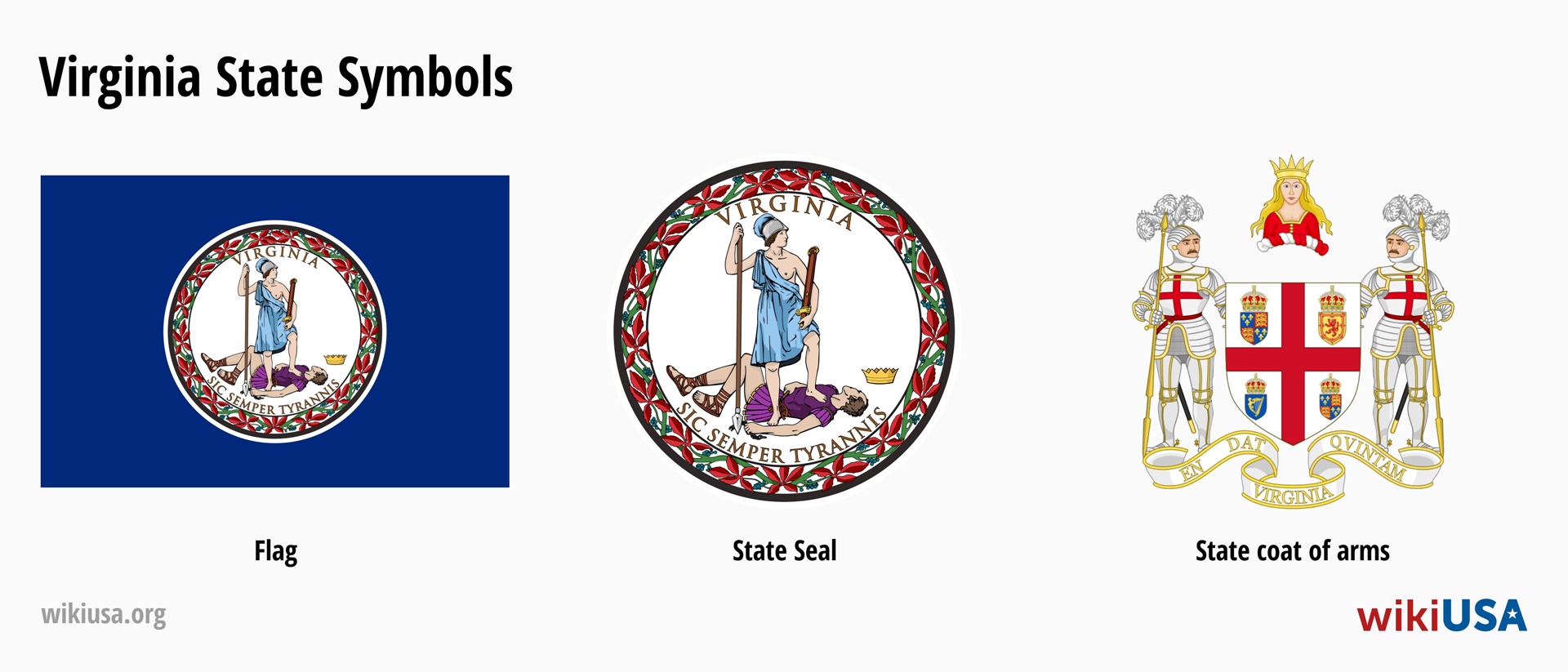
Virginia State Symbols
Most symbols are officially approved by the Virginia General Assembly in the form of a law and signed by the Governor. Only a few symbols are listed in this article.
State Flag of Virginia
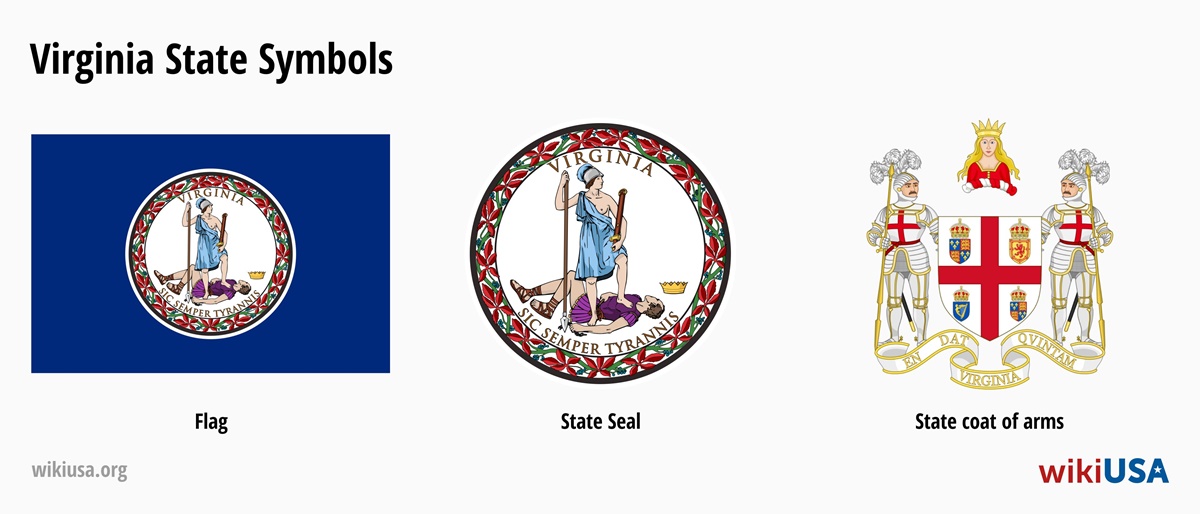
Virginia has a classic flag for American states, with the state seal on a dark blue background. The state flag was adopted on March 28, 1912, and was not officially enacted until February 1950.
Great Seal of Virginia
The state seal, like the flag, was first described in law on February 1, 1950. However, the first version of it came into use as early as 1776 after the Declaration of Independence from Great Britain.
On the front of the seal is the figure of Virtue (Virtus), which symbolizes courage and victory as he stands on a defeated tyrant. This is meant to represent triumph over oppression and tyranny. The figure holds a spear in one hand and a sword in the other, and below it is the Latin motto “Sic Semper Tyrannis”, which translates to “Thus always to tyrants”. The front of the seal is the official one, used to authenticate documents issued by the government.
State Motto
The official state motto of Virginia since 1776 has been the Latin “Sic semper tyrannis”, which translates to “thus always to tyrants”. The motto refers to gaining independence from Great Britain and states that tyrannical leaders will inevitably be overthrown.
State Flower
In 1918, the flowering dogwood (Cornus florida), a native species in Virginia, became the official symbol. It is common throughout the eastern seaboard of the USA. The flowers of the dogwood are white or pink in color.
State Tree
In February 1956, in a rather unusual move, the flowering dogwood (Cornus florida) simultaneously became the official tree of Virginia. The flowering dogwood is a small deciduous tree that grows up to 33 ft in height and is often wider than taller at maturity.
State Traditional Song
The official folk song of the state is the song Our Great Virginia; the corresponding law went into effect on July 1, 2015. The lyrics are by writer Mike Greenly, and the music from the original American song Oh Shenandoah was arranged by Jim Papoulis.
State Freshwater Fish
Since 1993, Virginia’s official freshwater fish has been the brook trout (Salvelinus fontinalis), which is a native species and commonly found in clear mountain streams and lakes.
State Bird
The northern cardinal (Cardinalis cardinalis) became the symbol of Virginia in 1950 and is the official bird of several other states. The red cardinal is one of the most common bird species in Virginia, typically growing to a length of 21 cm to 23 cm. Male cardinals are deep red, while females are brown with a hint of olive.
State Fossil
In 1993, the symbol was a fossil of the scallop Chesapecten jeffersonius, which lived four to five million years ago on the Virginia coast. The fossil is commonly found along major rivers in the Atlantic Coastal Plain.
State Insect
The eastern tiger swallowtail (Papilio glaucus) became one of Virginia’s symbols in 1991. The butterfly has spread throughout the state, and is popular among residents especially for its distinctive black and yellow coloration.




Contribute with Your Question or Personal Experience