
Ohio (OH) is a major industrial and agricultural center with a diverse economy. The economy is mainly driven by manufacturing, the aerospace and defense industries. The capital and largest city of Ohio is Columbus. Major tourist attractions include the Cedar Point amusement park and the Cuyahoga Valley National Park. Ohio was the first US state to pass a maximum speed limit law on roads in 1908.

-
Table of Contents
Quick Facts
Name Ohio Abbreviation OH Capital Columbus Largest city Columbus (Population: 913 175) Current time 12:54 Time zone EST (UTC-5), the state observes Daylight Saving Time EDT (UTC-4) Population 11,799,331 (#7 most populous US state) Area 44,825 mi² (#34 largest US state) Admitted to the Union March 1, 1803 (#17 state to join) ⭐ Capital of Ohio
The capital of Ohio is Columbus, which was founded for that purpose in 1812 at the confluence of the Scioto and Olentangy rivers. The name was chosen in honor of the Italian navigator Christopher Columbus, and it assumed the function of capital in 1816.
🏙️ Largest City in Ohio
The largest city in Ohio is Columbus, with a population of 913,175 in 2023. The second largest city is Cleveland with 362,656 residents, and the third largest is Cincinnati with 311,097.
🕒 Time in Ohio
The current time in Ohio is 12:54. The entire state is on Eastern Standard Time (EST, UTC-5) for most of the year, only switching to Daylight Saving Time between March and November.
🧑🤝🧑 Population of Ohio
According to 2023 data, the population of Ohio was 11,799,331, making the state the 7th most populous in the USA.
📍 Area of Ohio
Ohio’s total area is 44,825 mi², of which 40,987 mi² is land and 3,876 mi² is water. Ohio is the 34th largest US state.
-
Fun Facts About Ohio
🧩 Ohio Neighboring States
Ohio shares a land border with four different US states. Indiana to the west, Pennsylvania to the east, West Virginia to the southeast, and Kentucky to the south. The northern border is the shore of Lake Erie, across which it borders the state of Michigan.
📅 Date of Ohio Statehood
Ohio was admitted to the Union on March 1, 1803, as the 17th state in line to secede from part of the Northwest Territory.
📛 Nickname of the State of Ohio
Ohio is nicknamed “The Buckeye State”, referring to the naming of the state’s residents. It has been in use since the early 19th century, when then Ohio Senator and presidential candidate William Henry Harrison handed out souvenirs carved from buckeye trees in his campaign.
The term “buckeye” refers directly to the buckeye, which has been the official tree of Ohio since 1953.
The nickname “Birthplace of Aviation” is used on the license plates to commemorate the Wright brothers as citizens of Dayton, Ohio. Orville and Wilbur Wright were aviation pioneers and the creators of the first ever airplane, which flew in 12 seconds in 1903 120.0 ft.
⛰️ Highest Mountain in Ohio
The highest peak in Ohio is, with 1,549 ft, Campbell Hill, where a Cold War-era early warning radar was formerly located.
🏞️ Rivers in Ohio
The longest river in Ohio is the Ohio River with a total flow length of 981 mi. It is followed by the Wabash River (503 mi), Scioto River (231 mi), Great Miami River (162 mi) and Maumee River (137 mi).
🎓 Universities in Ohio
The largest educational institution is the Ohio State University, which was founded in 1870 in the city of Columbus and has around 58,000 students. The second-largest is University of Cincinnati with more than 42 thousand students. The third largest university is Kent State University, with just under 30 thousand students.
✉️ Ohio ZIP Codes
Ohio has a dedicated zip code range of 430xx-459xx, you can look it up by address on the USPS website. For more information, see the article ZIP Codes in the USA.
-
Weather in Ohio
The best time of year to visit Ohio is early fall, when temperatures are pleasant, there are fewer rainy days, and nature turns shades of orange and red.
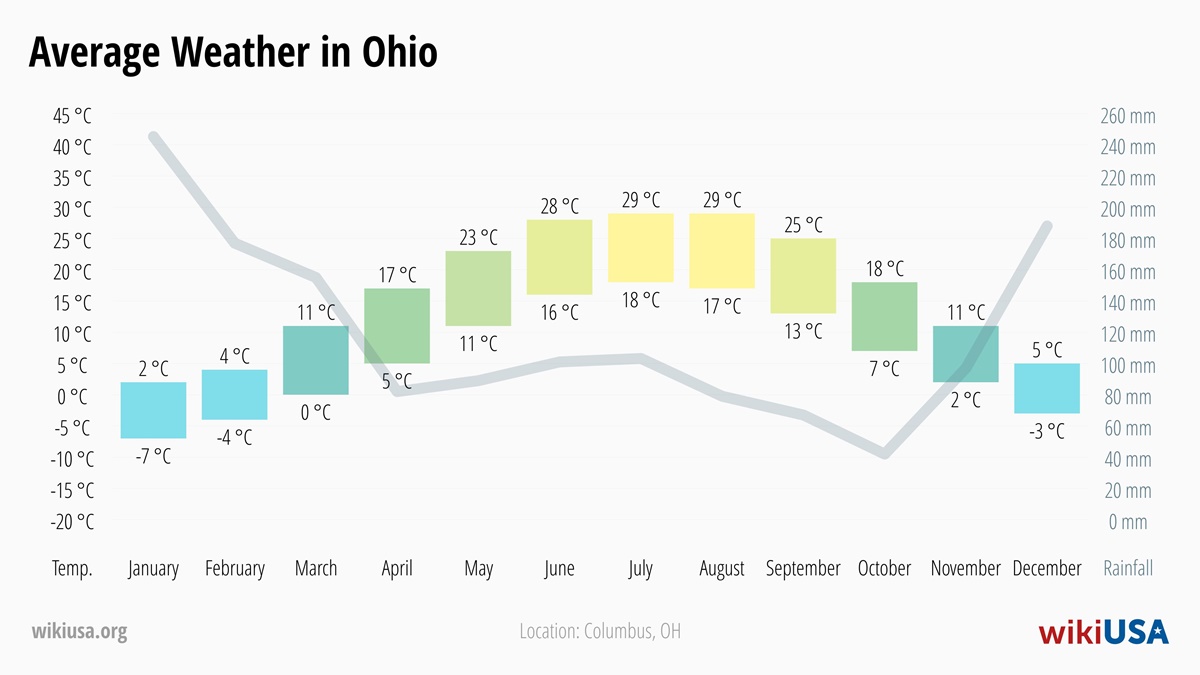
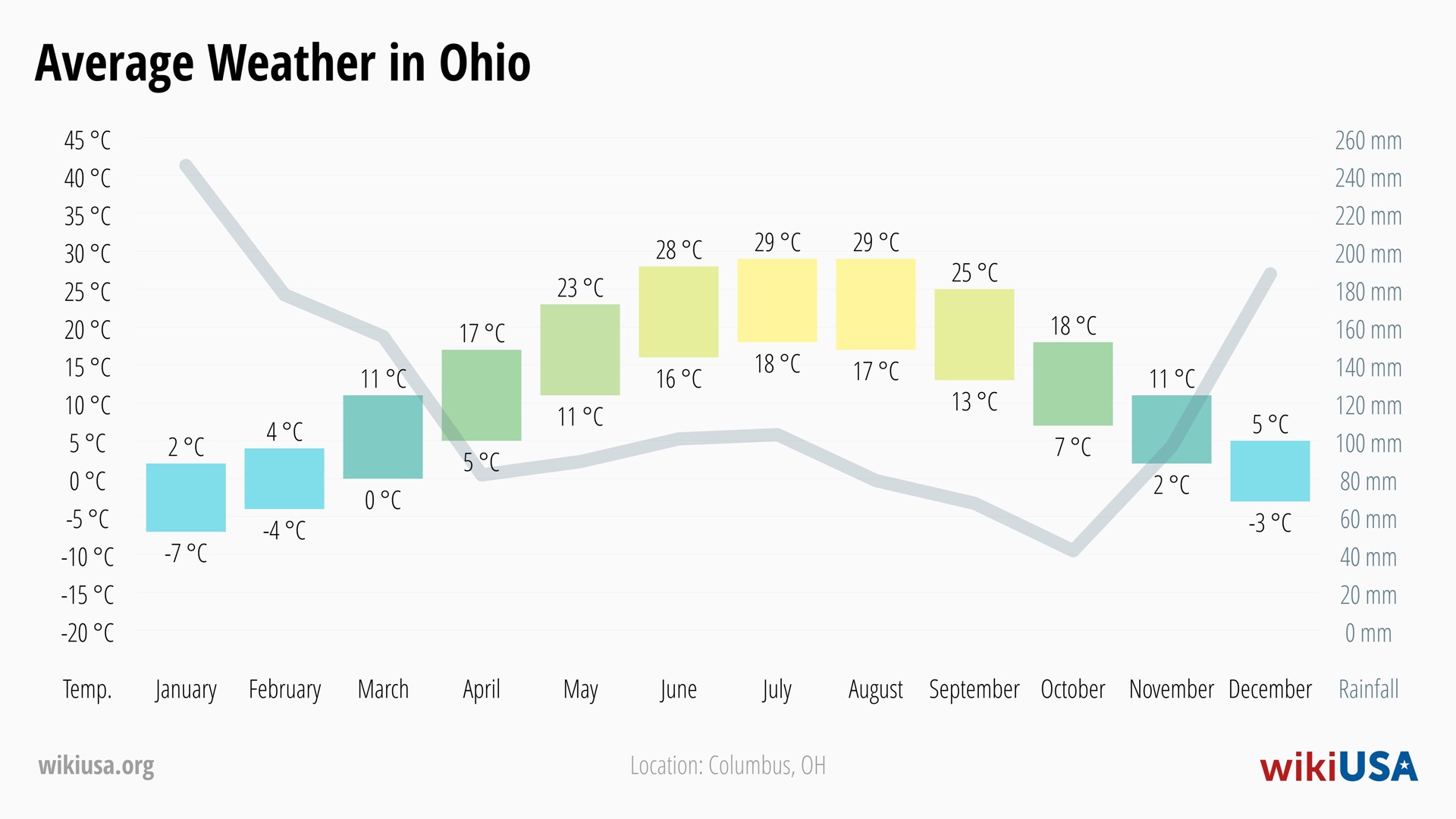
Spring in Ohio is very changeable in terms of weather. In March, temperatures on most days range between 32°F and 52°F, and in the following weeks it gradually warms up to May’s 52°F to 73°F. Higher elevations tend to be colder and snow cover may persist. Rainfall is very frequent and heavy in spring, especially in March and April.
Ohio summers are hot and muggy. The usual temperatures from June to August range between 61°F and 84°F, with significantly more rainy days compared to other American states. There is still a risk of tornadoes, although fewer than in the spring.
Autumn in Ohio is mild, with temperatures and rainfall dropping into more pleasant levels. Temperatures in September range from 55°F to 77°F, making this the best time of year to travel and visit the outdoors. Late October starts to cool down significantly to the usual 36°F to 52°F in November, when rainy days also increase significantly.
Winters in Ohio are cold, with temperatures between December and February typically ranging between 19°F and 41°F. Precipitation during this period is among the highest in the USA, with up to 50 cm of snowfall, especially in northern areas. Travel and tourism can be disrupted by snow storms or severe freezes, with temperatures dropping to -13°F.
🌡️ Average Temperatures and Precipitation in Ohio
-
Things to Do in Ohio
1️⃣ Cedar Point Amusement Park
Cedar Point in Sandusky, west of Cleveland, is considered one of the best amusement parks in the world. Among the 70 rides in operation are 17 roller coasters, some of which look rather scary to the eye.
Cedar Point also features less adrenaline-pumping attractions such as roller coasters, water slides and water boats. Families and groups of friends will have a great time at the park, and one day is hardly enough.
2️⃣ Cuyahoga Valley National Park
Cuyahoga Valley is Ohio’s only national park, known for its beautiful nature trails and waterfalls. There are about 125 mi hiking trails throughout the park that run along the Cuyahoga River, through forests, wetlands and meadows.
A popular hiking destination is the 60.0 ft high Brandywine Falls, which is easily accessible from a nearby road. The national park is a great place to escape into nature.
3️⃣ Cleveland Museum of Art
The Cleveland Museum of Art is one of the finest of its kind in the United States, with a collection of more than 61,000 works. It is known for its extensive collection of European, Asian and African art.
Among the most famous exhibits are the painting Life (1903) by Pablo Picasso and the cast of Auguste Rodin’s sculpture The Thinker, which was damaged in the 1970 Cleveland terrorist attack. Admission to the Cleveland Museum of Art is free.
4️⃣ Kings Island Amusement Park
Kings Island is a large amusement park near Cincinnati, visitors will find around seventy attractions. About a quarter of them are roller coasters, ranging from adrenaline-pumping ones with looping and high acceleration to slower trains designed for smaller children. The park also includes the Soak City Water Park, where you can refresh yourself in the summer months on water slides, slides and pools.
🗺️ Mason, Ohio
5️⃣ Pro Football Hall of Fame
The Pro Football Hall of Fame in Canton is dedicated to the sport’s greatest personalities. The museum displays collections of trophies, jerseys, photographs and other items that document the rich history of the NFL. An annual ceremony is held here to induct new members into the Hall of Fame.
🗺️ Canton, Ohio
6️⃣ Hocking Hills State Park
Hocking Hills State Park is located in Logan, southeast of Columbus, and is known for its beautiful scenery dominated by rock formations, caves and waterfalls. Across the hills are 25 mi hiking trails of varying difficulty, such as Cedar Falls and Old Man’s Cave. The best time to visit the park is autumn, when the leaves on the trees turn shades of red.
🗺️ Logan, Ohio
7️⃣ West Side Market
The West Side Market is Cleveland’s oldest market, in continuous operation since 1912, with dozens of stalls selling fresh baked goods, fruits, vegetables, fish and local specialties. The hallmark of the market is the brick clock tower.
8️⃣ Columbus Zoo & Aquarium
The Columbus Zoo and Aquarium is one of the largest and best-rated zoos in the United States. It opened its doors in 1927 and today houses over 10,000 animals of more than 800 different species.
Some of the zoo’s most popular pavilions include polar bears, Tasmanian devils, lions, giraffes and koalas. The zoo includes a marine world where you can watch fish, manatees or penguins in their natural habitat.
9️⃣ Rock and Roll Hall of Fame
The Rock and Roll Hall of Fame in Cleveland is a must-stop for all music fans. The museum displays original costumes, instruments and personal items of famous musicians. Elvis Presley, Chuck Berry, Johnny Cash, Jerry Lee Lewis, The Jackson 5, The Kinks and many more are represented in permanent and temporary exhibits. The Hall of Fame holds an annual ceremony when new musicians are inducted.
🔟 Ohio State Reformatory
The Ohio State Reformatory is a complex of former correctional buildings built between 1886 and 1910. The place became famous thanks to the movie The Shawshank Redemption, some scenes of which were filmed here.
Today, the prison, characterized by its neo-Gothic architecture, no longer serves its original purpose and has become a museum. Visitors can take a guided tour to learn about the history of the prison and the stories of its most famous prisoners.
-
Largest Cities in Ohio
The table below shows the ten largest cities in the state of Ohio in 2023, the source of the data is the United States Census Bureau, a federal agency whose main job is to count the population.
City County Population 1 Columbus Franklin, Delaware, Fairfield 913,175 Map of Columbus 2 Cleveland Cuyahoga 362,656 Map of Cleveland 3 Cincinnati Hamilton 311,097 Map of Cincinnati 4 Toledo Lucas 265,304 Map of Toledo 5 Akron Summit 188,701 Map of Akron 6 Dayton Montgomery, Greene 135,512 Map of Dayton 7 Parma Cuyahoga 78,951 Map of Parma 8 Canton Stark 69,197 Map of Canton 9 Lorain Lorain 65,337 Map of Lorain 10 Hamilton Butler 62,997 Map of Hamilton -
Sports Teams in Ohio
🏒 Ice Hockey (NHL)
The only club from Ohio in the famous NHL is the Columbus Blue Jackets, who play their home games at Nationwide Arena. The team was formed in 2000 and is part of the Metropolitan Division in the Eastern Conference. It considers its colors to be navy blue, red, silver and white.
🏈 American Football (NFL)
There are two teams from Ohio in the American Football League (NFL), both part of the North Division in the AFC Conference.
The Cleveland Browns entered the league in the 1950 season, playing their home games at Paycor Stadium in Cleveland. The club colors are brown, orange, and white.
The other club is the Cincinnati Bengals, who have been in the NFL since the 1970 season. The home venue is Paycor Stadium in Cincinnati, and the club colors are black, orange and white.
🏀 Basketball (NBA)
Since the 1970 season, Ohio’s only representative in the NBA basketball league is the Cleveland Cavaliers, who belong to the Central Division in the Eastern Conference. The team plays its home games at the Rocket Mortgage FieldHouse in Cleveland. The club colors are burgundy, gold and black.
⚾ Baseball (MLB)
Ohio is represented by two teams in the MLB baseball league.
The Cincinnati Reds participated in the National League as early as 1890, and now fall into its Central Division. The team plays its home games at the Great American Ball Park in Cincinnati; the club colors are red, black, and white.
The other Ohio team in MLB is the Cleveland Guardians of the American League’s Central Division. The Guardians play their home games at Progressive Field in Cleveland, listing navy blue, red and white as their club colors.
⚽ Soccer (MLS)
The MLS soccer league is played by two teams from Ohio, both in the Eastern Conference.
The Columbus Crew first participated in the 1996 season; the official club colors are black and gold. Home games are played at Lower.com Field in Columbus.
The other team is FC Cincinnati, which entered the MLS league for the 2019 season. All home matches are played at TQL Stadium in Cincinnati, the club colors are orange and blue.
-

Ohio State Symbols
All of Ohio’s official symbols have been approved by the state’s General Assembly, with the corresponding law signed by the governor. The article below lists only a few of these symbols.
State Flag of Ohio
Ohio’s state flag was adopted on May 9, 1902, and is unique among American states in its shape, resembling a swallow’s tail. The flag was designed by architect John Iesenmann, who designed it for the Pan-American Exposition in Buffalo in 1901. Ohio officially adopted its flag as one of the last US states to do so.
The flag’s atypical shape is meant to evoke the hills and valleys of Ohio, while the stripes symbolize roads and waterways. The letter “O” in the blue wedge is the first letter in the name of the state of Ohio and also recalls the nickname “Buckeye State”.
Great Seal of Ohio
The first version of the Great Seal of the State of Ohio came into use on March 25, 1803, and has undergone many modifications since then, most recently in 1996. The main motif of the seal is the sun rising over Mount Logan, which is meant to represent hope and a new beginning. The corn sheaf and thirteen arrows in the lower half represent agriculture and the thirteen original colonies of the United States.
State Tree
The official tree is the Ohio buckeye (Aesculus glabra). It became the symbol on October 20, 1953, and the tree is widely distributed throughout Ohio. The chestnut’s appearance resembles the eye of a deer, giving rise to the nickname “buckeye”.
State Flower
Since 3 February 1904, the carnation (Dianthus caryophyllus) has been the state flower. It was adopted in honor of former US President and local native William McKinley, who was fond of the flower and often wore it in his jacket lapel.
State Song
The national anthem was the 1969 song Beautiful Ohio, with lyrics written by Wilbert McBride. The music was written by American composer Robert A. King.
State Amphibian
Ohio’s symbol since 2010 is the spotted salamander (Ambystoma maculatum), chosen for its abundant presence in local forests and wetlands. The spotted newt is characterized by distinctive yellow spots and can live up to 20 years in the wild.
State Reptile
On November 24, 1995, a law went into effect making the northern black racer (Coluber constrictor constrictor) the official reptile. The initiative came from students who wanted to raise awareness of this snake, which is commonly found in the state.
State Bird
The General Assembly declared the northern cardinal (Cardinalis cardinalis) the state bird in 1933, and the selection was decided by a vote of children throughout the state. Only male cardinals are bright red in coloration; females are mostly brown with a hint of olive.
State Gem
Since August 1, 1965, the Flint Ridge Mine flint, known for its high quality and color, has been the official gemstone. The flint was also chosen for its cultural and historical value, as it was used by Native Americans to make weapons and tools.
State Beverage
Tomato juice became the official beverage of the State of Ohio by law effective October 6, 1965.





Contribute with Your Question or Personal Experience